
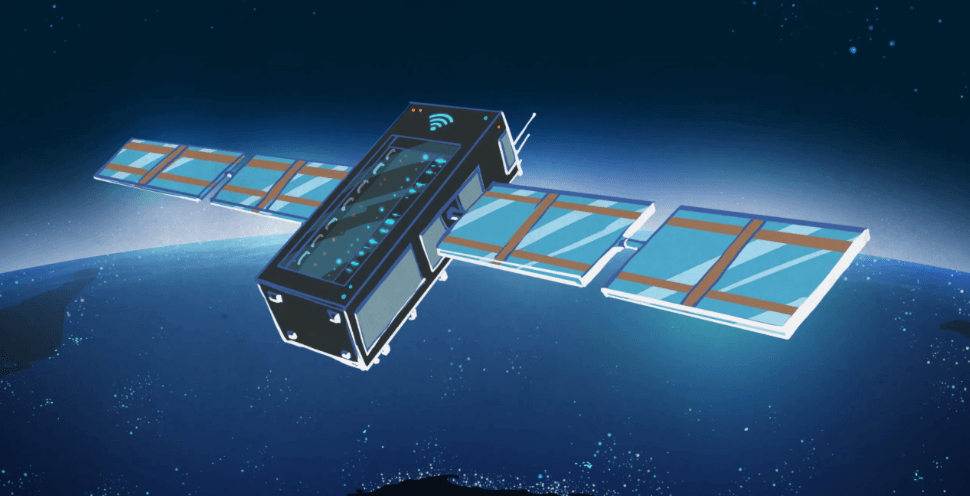
Remember when “the cloud” was just a metaphor? Well, things are about to get a lot more literal.
This week, Canada’s Kepler Communications announced that the world’s largest orbital compute cluster is officially open for business. And I’m not talking about a fancy new data center in Virginia or Singapore. I’m talking about 40 GPU processors floating 500 kilometers above your head, linked together by laser beams, processing data while orbiting Earth at 27,000 kilometers per hour.
If that sounds like science fiction, you’re not alone in thinking so. But it’s very much real, very much operational, and it might just be the beginning of one of the wildest technology shifts we’ll see in our lifetimes.
What Exactly Is Flying Up There?
Let’s start with the basics. In January 2026, Kepler Communications launched ten satellites into low Earth orbit. Each one carries multiple Nvidia Jetson Orin edge processors about 40 GPUs in total across the constellation. These satellites aren’t just floating around independently; they’re connected via optical laser links, forming what’s essentially a networked compute cluster in space.
Think of it like this: imagine your office’s server rack, but instead of sitting in a climate-controlled room in the basement, it’s hurtling through the vacuum of space, and instead of ethernet cables, the servers talk to each other with frickin’ laser beams.
The cluster went fully operational on March 16, 2026, and Kepler now has 18 paying customers using it to process everything from satellite imagery to defense data. Their newest customer, announced just this week, is Sophia Space a startup working on solving one of the biggest challenges in orbital computing.
But before we get into why this matters for businesses, let’s address the obvious question everyone’s asking.
Why Would Anyone Put a Data Center in Space?
I know what you’re thinking. We have perfectly good data centers on Earth. Why complicate things by launching computers into orbit?
The answer comes down to three things: power, cooling, and politics.
The Power Problem
Here on Earth, electricity is becoming AI’s biggest bottleneck. Training large language models and running inference at scale requires enormous amounts of power. We’re talking facilities that consume 13 megawatts or more enough to power tens of thousands of homes.
And that power isn’t cheap. It’s also not always available. Utilities are struggling to keep up with demand, and new data centers are being delayed or blocked because local grids simply can’t handle the load.
In space? It’s always sunny. Literally.
Satellites in certain orbits particularly sun-synchronous dawn-dusk orbits receive continuous solar power year-round. No nighttime downtime. No cloudy days. Just constant, free energy from the sun. Space-grade solar panels achieve 40-50% efficiency, and depending on the orbit, they can generate 5 to 13 times more energy annually than identical panels on Earth.
The Cooling Nightmare
If you’ve ever felt the bottom of your laptop after watching Netflix for a few hours, you understand heat. Now imagine that laptop is processing AI workloads 24/7. That heat has to go somewhere.
Terrestrial data centers consume billions of gallons of water annually for cooling. In some regions, this has become politically toxic communities are pushing back against new facilities that drive up electricity rates and drain water supplies.
Space offers a unique solution: it’s really, really cold. The background temperature sits near -270 degrees Celsius. Satellites can reject waste heat through passive thermal radiation directly into the vacuum of space. No water. No massive HVAC systems. Just physics.
Now, it’s not quite that simple (we’ll get to the challenges in a bit), but the fundamental principle holds: space offers natural advantages for managing heat that Earth-based facilities can’t match.
The Political Headwind
This one surprised me, but it’s becoming increasingly relevant. Communities across the United States and in other countries are pushing back against new data center construction. From local governments to President Trump, leaders are trying to limit the expansion of facilities that strain infrastructure and consume massive resources.
Just recently, Wisconsin banned new data center construction entirely. Atlanta has severely restricted where they can be built. Other jurisdictions are imposing strict power caps or outright moratoriums.
Sophia Space CEO Rob DeMillo put it bluntly: “Anything that limits data centers on Earth is making the space-based alternative more attractive.”
What Makes Kepler’s Cluster Different?
Here’s where things get interesting. Kepler isn’t trying to replace Amazon Web Services or build the next Google Cloud at least not yet. Their approach is much more pragmatic, and honestly, much smarter.
Kepler’s cluster is designed for edge processing handling data where it’s collected rather than shipping it back to Earth first.
Here’s a real-world example: imagine a satellite equipped with synthetic aperture radar scanning the Earth’s surface. It’s generating terabytes of raw data. Traditionally, that data gets downlinked to ground stations, then sent to terrestrial data centers for processing, then analyzed, and finally delivered to the customer.
That process takes time. A lot of time.
With Kepler’s orbital compute cluster, that same satellite can offload its raw data to a nearby GPU-equipped satellite in the constellation. The processing happens in orbit, and only the final, analyzed results get sent to Earth. The latency drops dramatically. The bandwidth requirements plummet. The responsiveness improves by orders of magnitude.
For military applications like the U.S. Space Development Agency’s missile defense system that needs to detect and track threats in real-time this kind of edge processing isn’t just convenient. It’s essential.
Kepler has already demonstrated space-to-air laser links for the U.S. government. They’re positioning themselves as the infrastructure layer that other satellites can tap into, rather than trying to be a standalone data center operator.
Mina Mitry, Kepler’s CEO, explained their philosophy: “We don’t view ourselves as a data center. We view ourselves as infrastructure to power satellite networking services.”
That distinction matters. They’re building the plumbing, not the building.
The Cooling Challenge Nobody’s Talking About
Remember earlier when I said space is really cold? That’s true. But here’s the catch: space is also a vacuum.
On Earth, when your computer gets hot, air flows over the heatsink, carrying heat away. In space, there’s no air. Heat doesn’t dissipate easily it just builds up.
This is where Sophia Space enters the picture. They’re developing passively-cooled space computers systems that can manage heat without heavy, expensive active-cooling mechanisms. As part of their partnership with Kepler, Sophia will upload their proprietary operating system to one of Kepler’s satellites and configure it across six GPUs on two spacecraft.
This will be the first time anyone has attempted distributed software orchestration in orbit. It’s table stakes for a terrestrial data center, but in space, it’s genuinely groundbreaking.
Why does this matter? Because solving the thermal management challenge is critical to scaling orbital data centers from edge processors to full-scale compute facilities. If Sophia’s passive cooling technology works, it removes one of the biggest barriers to making space-based data centers economically viable.
Their first satellite launch is planned for late 2027. The test on Kepler’s constellation is essentially a de-risking exercise proving the software works in the harsh orbital environment before committing to their own hardware.
The Billion-Dollar Space Race
While Kepler is the first to market with an operational cluster, they’re far from alone in this race.
Starcloud: The Unicorn
Just two weeks ago, Seattle-area startup Starcloud announced $170 million in funding, vaulting them to unicorn status with a $1.1 billion valuation. They’ve become the fastest company in Y Combinator history to hit that milestone just 17 months after their demo day.
Starcloud is taking a more ambitious approach than Kepler. They’re building purpose-designed orbital data centers with higher-capacity processors. In 2025, they deployed an Nvidia H100-class system and became the first company to train a large language model in space and run a version of Google Gemini beyond Earth’s atmosphere.
CEO Philip Johnston acknowledges the skepticism they’ve faced. “If you go back to some of the comments on X when we announced, people said it was impossible and we couldn’t do it.”
He’s betting that within three to five years, the economics will shift in space’s favor. Even then, he expects less than 1% of new compute capacity will launch in orbit initially. But about a decade out, he believes satellite data centers “will be by far the fastest growing segment.”
The Tech Giants Are Watching
Google isn’t sitting this one out. Their Project Suncatcher is taking a vertically integrated approach, pairing custom Trillium TPU v6e chips with Planet Labs’ satellite expertise. They’ve confirmed the chips can survive radiation levels across a five-year orbital mission and demonstrated 1.6 terabits per second using laser transceivers.
Google is modeling formation-flying clusters of up to 81 satellites spaced hundreds of meters apart at roughly 650 kilometers altitude. Two prototype satellites are slated for launch in early 2027.
Microsoft President Brad Smith recently said the company might eventually pursue orbital data centers, but “we’re keeping our feet on the ground” for now. It’s a cautious wait-and-see approach from Redmond.
SpaceX and Elon’s Million-Satellite Vision
And then there’s Elon Musk. Because of course there is.
At a March event, Musk announced that SpaceX which has merged with his AI company xAI into a $1.25 trillion entity would launch data centers into orbit. He’s filed FCC applications for up to one million satellites.
Yes. One million.
Musk’s pitch is simple: “You’re power constrained on Earth. Space has the advantage that it’s always sunny.”
His concept includes “AI Sat Mini” spacecraft with solar arrays spanning roughly 180 meters about 600 feet. These aren’t small satellites. They’re orbital power plants with computers attached.
Blue Origin, Jeff Bezos’s space venture, has announced the TeraWave constellation of about 5,400 satellites designed to provide high-throughput networking for distributed computing.
The Startup Ecosystem Is Exploding
Beyond the big names, a whole ecosystem is emerging:
- Aetherflux, founded by Robinhood co-founder Baiju Bhatt, raised $50 million for their “Galactic Brain” project, which combines orbital compute with power-beaming technology that transmits energy to Earth via infrared laser.
- Atomic-6, a Georgia startup, just launched ODC.space an actual marketplace where companies can order orbital data center capacity on-demand, with delivery in 2-3 years.
- Axiom Space deployed two orbital data center nodes on the same January launch as Kepler’s constellation, building on their prototypes tested aboard the International Space Station.
The momentum is undeniable. This isn’t a fringe concept anymore. It’s an emerging industry with serious capital behind it.
The Business Case: When Does This Actually Make Sense?
Okay, so orbital data centers are technologically impressive. But do they make business sense?
The answer right now is: “It depends.”
Where It Works Today
For certain applications, the case is already compelling:
Defense and Intelligence: The U.S. military is a major customer. Real-time processing for missile defense, signals intelligence, and reconnaissance simply can’t afford the latency of bouncing data to Earth and back. Processing at the edge in orbit provides a decisive advantage.
Earth Observation: Companies running satellite constellations for imaging, weather monitoring, or environmental tracking generate enormous amounts of raw data. Processing it in orbit before downlinking saves bandwidth and accelerates insights.
Communications Networks: Low-latency processing for satellite internet services like Starlink could be enhanced with onboard compute that handles routing, optimization, and content delivery closer to the user.
Where It Doesn’t (Yet)
For general-purpose cloud computing? We’re not there yet.
Training large AI models requires enormous, sustained compute across tightly networked processors. The latency of laser links between satellites, while fast, still introduces delays that make distributed training challenging. And the power requirements for training versus inference are simply massive.
Philip Johnston of Starcloud is realistic: orbital compute “won’t displace terrestrial data centers anytime soon.”
The economics also remain challenging. Varda Space Industries, a skeptic in this space, calculates that orbital compute costs roughly three times more per watt than terrestrial equivalents when you factor in launch costs, limited lifespan, and maintenance difficulties.
But those economics are shifting. Launch costs are plummeting thanks to reusable rockets. Satellite longevity is improving. And most importantly, the constraints on Earth-based expansion are tightening.
The Technical Hurdles Nobody’s Solved Yet
Let’s be honest about the challenges, because they’re significant.
Maintenance and Upgrades
Walk into any terrestrial data center, and you’ll see technicians constantly upgrading hardware, swapping failed components, and reconfiguring systems. James Mathes, who manages a 144,000-square-foot facility in Virginia, put it simply: “We have vendors here every single day.”
In space? Good luck with that.
Once a satellite is in orbit, it’s essentially disposable. If a processor fails, you can’t just pop open the chassis and swap in a new one. When technology becomes obsolete which in the compute world happens quickly you can’t upgrade the chips. You have to launch new satellites.
On-orbit servicing is emerging as a potential solution, but it’s still experimental and expensive. For now, satellites are single-use assets with limited lifespans, typically five to ten years.
Heat Dissipation at Scale
While passive cooling works for edge processors like Nvidia Orins, scaling up to data center-class GPUs is a different challenge entirely. The Nvidia H100s and next-generation chips consume kilowatts of power and generate tremendous heat.
Managing that heat without heavy active-cooling systems which add weight, complexity, and points of failure is an unsolved engineering problem. It’s why passive cooling innovations like Sophia’s are so critical to the industry’s future.
Data Latency and Bandwidth
Even at the speed of light, transmitting data between satellites in a constellation introduces latency. For applications that require tightly synchronized processing across many nodes, that latency matters.
Google’s approach flying satellites in extremely tight formations helps minimize this, but it introduces other challenges around station-keeping and orbital mechanics.
Space Debris and Sustainability
Here’s an uncomfortable question: what happens to all these satellites when they’re obsolete?
Space debris is already a serious problem. Adding millions of satellites as Musk proposes raises legitimate concerns about orbit pollution and the long-term sustainability of space operations.
Unlike terrestrial e-waste, which we already struggle to recycle properly, orbital debris can’t be collected and processed. It just stays up there, creating collision risks for decades.
What This Means for Different Industries
If you’re trying to figure out how orbital computing might affect your sector, here’s my take:
If You’re in Defense or Intelligence
This is already your future. The advantages of low-latency, on-orbit processing for sensor networks, missile defense, and reconnaissance are too significant to ignore. Expect rapid adoption and serious budgets allocated to this capability.
The Space Development Agency is already implementing algorithms in space as part of its Proliferated Warfighter Space Architecture. Orbital compute is a prerequisite for the modern battlespace.
If You’re in Satellite Operations
You need to be planning for this now. Whether you partner with infrastructure providers like Kepler or build your own capabilities, offloading processing to orbital compute will become table stakes for competitive performance.
CEO Mina Mitry reports that satellite companies are already designing future assets around this model, particularly for power-hungry sensors like synthetic aperture radar.
If You’re in AI/ML Development
For inference workloads especially those tied to space-based data collection the business case is becoming clear. For training? We’re still years away from orbital clusters competing with terrestrial facilities.
But keep an eye on power constraints on Earth. If regulatory pressures continue to limit new data center construction and electricity costs keep rising, the calculus could shift faster than expected.
If You’re in Traditional Cloud/Data Center Business
You’re probably safe for now. The economics don’t yet support moving general-purpose compute to orbit. But the directional trend is real, and the startups raising billions to chase this vision aren’t delusional.
Think of orbital compute as a new tier emerging above edge computing: ultra-edge, space-based processing for specific workloads where latency and Earth-based constraints create opportunity.
The Regulatory Wild West
Here’s something that doesn’t get enough attention: the regulatory framework for orbital data centers barely exists.
Who regulates data centers in space? What privacy laws apply? What about data sovereignty when your data is orbiting above multiple countries every 90 minutes? What environmental reviews are required for launches? How do you enforce spectrum allocation when satellites are laser-linking across constellations?
These aren’t hypothetical questions. They’re live issues that will need answers as the industry scales.
SpaceX’s filing for a million satellites prompted immediate concerns from astronomers and space sustainability advocates. The FCC will need to develop entirely new frameworks for managing orbital infrastructure at this scale.
For businesses considering using orbital compute, the regulatory uncertainty is a real risk. Policies could change rapidly, potentially impacting operations or costs in ways that are hard to predict.
The Timeline: When Does This Go Mainstream?
Based on the current trajectory, here’s my best guess on timing:
2026-2027: Early adoption phase. Defense, intelligence, and specialized satellite operators use orbital edge computing for specific workloads. Multiple proof-of-concept missions fly. Infrastructure providers like Kepler expand capacity.
2028-2030: Commercial viability phase. Costs drop as launch rates increase. More startups enter the market. The first large constellations (beyond Kepler’s initial tranche) become operational. Use cases expand to include data-intensive applications beyond defense.
2030-2035: Scaling phase. Major tech companies deploy their own orbital infrastructure. The economics reach parity with constrained terrestrial options for certain workload types. Regulatory frameworks mature. On-orbit servicing becomes more common.
2035+: Potential inflection point. If the technology, economics, and regulations align, orbital compute could begin capturing a meaningful percentage of new capacity additions particularly for AI inference and data-intensive applications.
That timeline assumes no major setbacks (like a catastrophic collision event creating debris fields) and continued progress on launch costs, thermal management, and on-orbit operations.
Why Kepler’s Announcement Matters More Than You Think
Coming back to where we started: Kepler Communications launching the world’s largest operational orbital compute cluster is significant not because it’s the end game, but because it’s proof of concept.
For years, orbital data centers were theoretical. Companies talked about them. Investors pitched them. But nobody had actually done it at meaningful scale.
Now someone has. Forty GPUs across ten satellites, connected by lasers, processing real customer workloads. Eighteen paying customers. A partnership to test distributed software orchestration in orbit for the first time.
It’s not massive yet. It’s not going to replace AWS tomorrow. But it’s real, it’s operational, and it’s open for business.
That’s the milestone that matters. Once you prove something can be done, the question shifts from “if” to “how much” and “how fast.”
The Contrarian Take
Let me offer a counterpoint to all this enthusiasm: maybe orbital data centers are a solution looking for a problem.
Yes, power and cooling are challenges on Earth. But we’re also getting better at managing them. New chip architectures are becoming more energy-efficient. Renewable energy is getting cheaper. Advanced cooling technologies are emerging.
And let’s be honest: space is hard. Really hard. Launching things costs money. Satellites have limited lifespans. Maintenance is nearly impossible. Radiation damages electronics. Debris creates risks.
For most computing workloads, Earth remains far more practical. The idea that we’d move general-purpose cloud computing to orbit anytime soon seems, frankly, unlikely.
The real opportunity and the one Kepler is actually pursuing is much more modest: niche applications where processing data in orbit provides clear advantages over terrestrial alternatives. Edge computing for satellites. Military applications requiring low latency. Specialized inference workloads.
That’s a real business. It’s just not the trillion-dollar revolution some are pitching.
What Should You Actually Do With This Information?
If you’re a business leader trying to make sense of all this, here’s my practical advice:
If you’re in a relevant sector (defense, satellite operations, specialized AI applications), start conversations with providers like Kepler now. Understand their capabilities, pricing, and roadmaps. Run pilots if it makes sense. The early movers in any new infrastructure paradigm often capture disproportionate advantages.
If you’re in adjacent industries, keep watch on the regulatory developments and economic trends. If terrestrial data center constraints continue tightening while launch costs keep falling, the calculus could shift faster than expected. Have a perspective on when if ever orbital compute might become relevant to your operations.
If you’re an investor, recognize that we’re in the early innings of what could be a major infrastructure buildout, or what could be an overhyped bubble. The companies that survive will likely be those focused on solving real, specific problems rather than chasing grand visions. Infrastructure plays like Kepler probably have more sustainable business models than companies trying to replace AWS from orbit.
If you’re a technologist, this is a genuinely interesting problem space with hard engineering challenges. Thermal management, radiation tolerance, distributed computing in high-latency environments, on-orbit servicing these are all problems that need solving. The work is cool even if the market ends up smaller than the hype suggests.
The Bottom Line
Computing has officially left the planet. Kepler’s orbital cluster is operational. Sophia Space is testing distributed software in the vacuum of space. Starcloud is a unicorn. Google has prototypes planned. SpaceX wants to launch a million satellites.
Is this the future of all computing? Probably not.
Is this the future of certain types of computing, particularly those tied to space-based data collection, defense applications, and scenarios where Earth-based constraints create insurmountable problems? Almost certainly.
The gap between those two scenarios is where all the interesting questions live. How big does this market actually get? How fast do economics improve? What regulatory frameworks emerge? Which technical challenges get solved, and which prove insurmountable?
I don’t have definitive answers to those questions. Nobody does yet. But for the first time, we’re not just speculating we’re watching it happen in real-time.
The largest orbital compute cluster is open for business. Customers are using it. More capacity is coming. The race is on.
Whether this is the dawn of a new era in computing or an expensive niche market for specialized applications, we’re about to find out.
One thing’s certain: the cloud just got a whole lot more literal.
Leave a Reply