
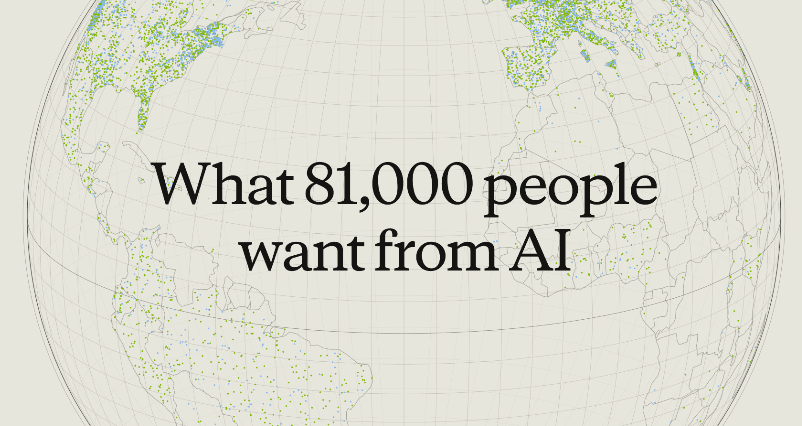
Anthropic just published the largest qualitative AI study ever conducted, and the findings destroy the narrative that people are either “AI optimists” or “AI pessimists.”
Over one week in December 2025, 80,508 Claude users across 159 countries and 70 languages sat down with Anthropic Interviewer a version of Claude specifically trained to conduct conversational interviews and answered open-ended questions about their AI hopes, fears, and experiences.
The study’s central finding is both profound and unsettling: the things people love most about AI are often the very things they fear.
Someone who values AI for emotional support is three times more likely to fear becoming dependent on it. Someone using AI to learn is also worried about cognitive atrophy. Professionals who trust AI for critical decisions also have stories about getting burned when it failed.
Anthropic calls this the “light and shade” effect and it reveals that AI adoption isn’t being held back by skeptics who don’t see value. It’s being held back by users who see tremendous value and are terrified of the consequences.
Published March 18, 2026, the study represents the first time AI has enabled researchers to collect rich, qualitative interviews at this extraordinary scale. What they discovered challenges almost everything we think we know about how people relate to AI.
Let me walk through the major findings, what they mean for AI adoption, why this matters for businesses deploying AI, and what it tells us about the future of human-AI collaboration.
The Methodology: AI Interviewing 81,000 People About AI
First, let’s appreciate the research innovation here.
Traditional Qualitative Research Limits
Typically, qualitative studies (interviews, focus groups) max out at a few hundred participants because:
- Interviews are time-intensive
- Analysis is manual and slow
- Cross-cultural research requires multilingual researchers
- Cost scales linearly with participants
Result: Most qualitative AI research interviews dozens or maybe hundreds of people, then extrapolates.
What Anthropic Did Differently
Anthropic Interviewer: A specially-prompted version of Claude designed to conduct adaptive, conversational interviews
Scale: 80,508 responses across 159 countries in 70 languages over one week (December 2025)
Process:
- Users with Claude.ai accounts invited to participate
- Anthropic Interviewer conducted structured conversations about AI usage, hopes, and fears
- Claude also analyzed transcripts filtering spam, classifying responses, identifying themes
- Human researchers synthesized findings
The innovation: AI enables qualitative research at quantitative scale. You get the depth of open-ended conversations with the statistical power of massive sample sizes.
The limitation: Anthropic is upfront that this sample “skewed toward people who have found enough value in AI to keep using it, and likely toward more positive visions than a general population sample would produce.”
Nearly half of respondents came from North America and Western Europe. This is a study of Claude users, not a representative global sample.
But even accounting for selection bias, 80,000+ voices across 159 countries represents something unprecedented.
The Core Finding: Light and Shade
The study’s most important discovery:
People don’t divide into AI believers and skeptics. They experience hope and fear simultaneously, rooted in the same capabilities.
The Five Tensions
Anthropic identified five recurring patterns where AI benefits and harms emerge from the same source:
1. Cognitive Enhancement vs. Cognitive Atrophy
The benefit: AI helps people learn, understand complex topics, solve problems The fear: Relying on AI erodes thinking ability, critical reasoning skills atrophy
Real quote from Israeli lawyer:
“I use AI to review contracts, save time… and at the same time I fear: am I losing my ability to read by myself? Thinking was the last frontier.”
The correlation: People who use AI most intensively for learning are also most worried about losing cognitive abilities.
2. Time-Saving vs. Illusory Productivity
The benefit: AI automates mundane tasks, freeing time for higher-value work The fear: Productivity gains get absorbed by increased workload expectations; the treadmill just speeds up
What people actually want: When researchers pushed on why respondents wanted “productivity gains,” answers kept drifting to the same place: more time for life outside work.
“Using AI to automate emails became, in actuality, a desire to spend more time with family.”
A third of all visions collapsed into this single request: make room for the parts of life that modern work has crowded out.
The irony: People hope AI gives them personal time back. They fear it just intensifies work demands.
3. Emotional Support vs. Dependency
The benefit: AI provides non-judgmental emotional support, available 24/7
- Ukrainians seeking solace during war
- People processing grief after losing a parent
- Mental health support when professional help isn’t accessible
The fear: Becoming dependent on AI for emotional needs, avoiding difficult human conversations
The correlation: Someone who values emotional support from AI is three times more likely to fear becoming dependent on it.
Quote from study:
“The same availability that makes Claude a grief counselor at 3 a.m. also makes it easier to avoid a difficult conversation with a friend.”
4. Economic Empowerment vs. Job Displacement
The benefit: AI enables entrepreneurship, side projects, business creation
- 47% of independent workers report real economic empowerment
- 58% of employees with side projects see economic gains
- Only 14% of salaried employees report benefits
The fear: AI replacing jobs, wage stagnation, widening inequality
- 22.3% named job displacement as their biggest worry
- Spread fairly evenly across professions
Real quote from US software engineer:
“When I am coding now, I am mostly just an observer, not a creator anymore. I can see that even for the observer role, I might not be needed.”
Real quote from someone who got laid off:
“I got laid off from my job in May because my company wanted to replace me with an AI system.”
The divergence: This is the one tension where hope and fear diverge most. Economic benefits skew heavily toward independent workers. Displacement fears spread broadly.
5. Improved Decision-Making vs. Unreliable Judgment
The benefit: AI helps analyze complex decisions, surface insights, process information The fear: AI making poor or incorrect decisions, being unreliable
The negative outweighs positive here:
- 27% concerned about AI making poor decisions
- 22% cited improved decision-making as a benefit
Quote from study: “Every professional who has trusted AI judgment on something that mattered has a story about getting burned.”
The pattern: Lawyers showed this most intensely nearly half encountered AI unreliability firsthand, but also reported highest rates of realized decision-making benefits.
The Critical Pattern: Benefits Are Real, Fears Are Anticipatory
Across all five tensions, benefits were described from lived experience, while fears were largely anticipatory fear of what might happen, not what has already happened.
What this means:
- People aren’t rejecting AI because it doesn’t work
- They’re worried it works too well and will fundamentally change them/society
- The barrier to AI adoption isn’t capability it’s trust in long-term consequences
What People Actually Said: The Raw Testimonials
Some of the most powerful findings come from direct quotes:
Hope Stories
Medical diagnosis:
“Claude put the historical pieces together, leading to my proper diagnosis after being misdiagnosed for over 9 years.”
Economic mobility:
“I live hand to mouth, zero savings. If I use AI smarter, it may help me craft solutions to that cycle. It still depends on me.”
Learning:
“AI helped me understand quantum physics in a way no textbook ever did.”
Emotional support:
“After my mother passed, I didn’t want to burden my family. Claude listened when I needed to talk at 3 AM.”
Fear Stories
Job displacement:
“I got laid off from my job in May because my company wanted to replace me with an AI system.”
Cognitive decline:
“I use AI to review contracts, save time… and at the same time I fear: am I losing my ability to read by myself? Thinking was the last frontier.”
Loss of creativity:
“When I am coding now, I am mostly just an observer, not a creator anymore.”
Dependency:
“I find myself asking Claude things I should figure out myself. What happens when it’s not available?”
The Paradox Stories (Same Person, Both Hope and Fear)
These are the most revealing people expressing contradictory feelings simultaneously:
“AI saves me hours every day. But I wonder if I’m just filling those hours with more work instead of living.”
“I love that Claude helps me learn new topics. I worry I’m outsourcing my thinking.”
“AI helped me start a side business. I’m terrified it will make my main job obsolete.”
The Geographic Patterns: Who’s Most Optimistic?
The study revealed clear regional differences:
Overall AI Sentiment by Region
Most positive: Sub-Saharan Africa, Latin America, South Asia (70%+ positive sentiment)
Less positive (but still majority positive): North America, Western Europe, Oceania (60-67% positive)
Key insight: AI sentiment is majority-positive everywhere. No country dipped below 60%. But lower and middle-income countries are reliably more positive.
Why the Regional Divide?
Wealthy regions worry about:
- Governance gaps and regulatory failure
- Surveillance and privacy
- Job displacement in stable economies
- AI ethics and misuse
Developing regions emphasize:
- Economic equalizer potential
- Access to education and services
- Entrepreneurship and business creation
- Leveling the global playing field
Quote from unnamed participant:
“I see AI as the great equalizer. One of the beautiful things about AI is that in rural Indonesia or Brazil, [people] have access to the same AI as [in] the U.S.”
The tension: Wealthy countries fear losing what they have. Developing countries hope to gain what they lack.
What People Want Most: Professional Excellence and Personal Time
When asked what they sought from AI, the top categories were:
19% – Professional excellence: Being better at their job 18.8% – Productivity: Getting more done faster 16% – Learning: Understanding new topics 12% – Creativity: Generating ideas, creating content 11% – Economic empowerment: Making money, starting businesses
But when researchers asked follow-up questions “Why do you want productivity gains?” the answers converged:
33% of all visions collapsed into: More time for life outside work, family, hobbies, rest, personal fulfillment.
The revelation: People don’t actually want to be more productive. They want productivity gains to buy back their lives.
The Top 5 Fears: What Keeps People Up At Night
89% of respondents had fears about AI. Only 11% reported zero concerns.
The five main fears:
1. Unreliability (27%): AI making poor or incorrect decisions 2. Job displacement (22.3%): Economic impact, unemployment, inequality 3. Human passivity (22%): Decisions made without human oversight, becoming passive consumers 4. Cognitive atrophy (16%): Losing ability to think critically 5. Governance gaps (15%): Lack of regulation, unclear accountability
Lawyers showed the starkest divide: Nearly 50% experienced AI unreliability firsthand, but also reported the highest rates of decision-making benefits.
What This Means for Businesses Deploying AI
The study has massive implications for enterprise AI adoption:
Implication 1: Don’t Sell AI as “Replacement”
Positioning AI as “replacing human work” triggers displacement fears and resistance.
Better framing: AI as augmentation, copilot, tool that handles tedious work so humans focus on high-value tasks.
The study shows: Independent workers (entrepreneurs, side projects) experience 3x the economic benefits of salaried employees. Why? They control how AI augments their work rather than fearing it replaces them.
Implication 2: Address Anticipatory Fears Proactively
People’s fears are largely hypothetical based on what might happen, not what has happened.
Opportunity: Transparent communication, clear policies, and governance frameworks can convert anticipatory fears into informed trust.
Anthropic’s recommendation: “Organizations can prioritize user education, transparent model behavior, and opt-in controls to convert anticipatory fears into informed governance.”
Implication 3: Measure Both Benefits AND Fears
Traditional ROI metrics miss half the picture. If employees experience productivity gains but fear job displacement, you have an adoption problem brewing.
What to track:
- Productivity/quality improvements (benefits)
- Employee anxiety about job security (fears)
- Usage patterns (are people using AI or avoiding it?)
- Stories of success AND failure
Implication 4: The “Light and Shade” Effect Applies to Your Deployment
Whatever benefits your AI deployment delivers will likely generate corresponding fears:
- AI answering customer questions → employees fear customer service jobs disappearing
- AI writing code → developers fear becoming obsolete
- AI analyzing data → analysts worry about losing analytical skills
Strategy: Acknowledge both sides. Celebrate benefits. Address fears. Make both visible.
Implication 5: Focus on Life Balance, Not Just Productivity
The study shows people don’t want to work more they want to work less while maintaining quality.
The pitch: “AI lets you leave work at 5 PM instead of 7 PM” resonates more than “AI lets you be 20% more productive.”
The Timing: Why This Study Matters Now
This research arrives at a critical moment:
Claude’s momentum: Business subscriptions grew 4.9% month-over-month in February 2026. Daily time spent with Claude tripled from 10 minutes to 30+ minutes between January 2025 and January 2026.
ChatGPT’s decline: U.S. mobile market share fell from 69.1% to 45.3% as competitors gained ground.
Anthropic vs. Pentagon: The Department of Defense designated Anthropic a “supply chain risk” after the company refused to remove model guardrails for military applications. This public dispute boosted Claude’s profile.
You can read this study two ways:
Optimistic reading: Anthropic is emboldened by growth, sharing insights from a position of strength.
Skeptical reading: Anthropic is anxious about user retention and trying to understand what keeps people engaged versus what drives them away.
Either way, 80,000 voices matter more than corporate speculation.
The Bottom Line: AI Adoption Is an Emotional Challenge, Not a Technical One
The Anthropic study demolishes the idea that AI adoption is about building better models or adding more features.
The technical problems are largely solved. Claude can write code, analyze data, create content, answer questions, provide emotional support. The models work.
The human problem remains unsolved. People experience cognitive dissonance simultaneous hope and fear that makes sustained AI adoption psychologically difficult.
A lawyer who saves hours with AI contract review also worries they’re losing the ability to read contracts manually. Both feelings are real. Both are valid. And they coexist in the same person.
For AI companies: This means the path to widespread adoption isn’t better benchmarks or faster inference. It’s addressing the “light and shade” effect helping people navigate the tension between benefits they experience and harms they anticipate.
For individuals: If you feel conflicted about AI excited about what it enables, worried about what it might cost you’re not alone. 89% of users share your concerns. And the benefits you’re experiencing are real, even if the fears feel equally real.
For society: We need to move beyond “AI optimist vs AI pessimist” framing. The real conversation is: How do we maximize AI’s benefits while mitigating the fears that come bundled with those same benefits?
The 81,000 people Anthropic interviewed don’t have the answer. But they’ve clarified the question.
And that’s progress.
Anthropic’s full study “What 81,000 people want from AI” is available at anthropic.com/81k-interviews. The research was conducted in December 2025 and published March 18, 2026. Participants spanned 159 countries and 70 languages. Anthropic acknowledges the sample skewed toward active Claude users and may not represent general population sentiment.
Leave a Reply