
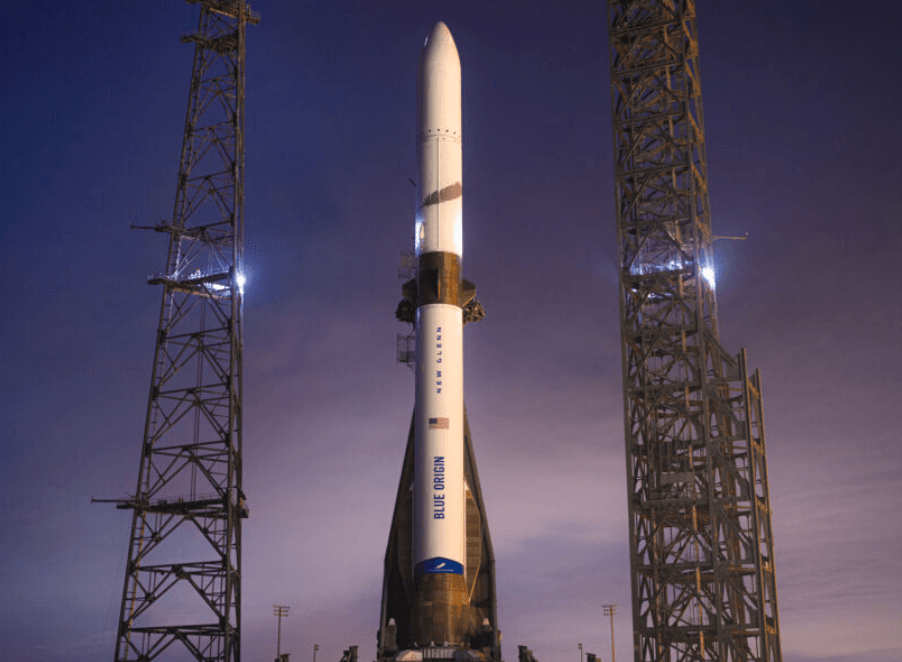
Sunday morning in Cape Canaveral started with promise. Jeff Bezos’ Blue Origin was about to make history launching a reused orbital rocket for only the third time ever, a feat that would put them in rare company alongside SpaceX. The towering 322-foot New Glenn rocket lit up the Florida sky at 7:25 AM, its seven BE-4 engines roaring to life with nearly 4 million pounds of thrust.
Ten minutes later, the first-stage booster aptly named “Never Tell Me The Odds” executed a flawless landing on the recovery ship Jacklyn, floating somewhere in the Atlantic. Jeff Bezos himself shared the landing footage on social media, a moment of triumph for a company that’s spent over a decade developing this rocket.
But that’s where the good news ended.
Several hours after launch, Blue Origin confirmed what industry watchers had begun to suspect: the rocket’s upper stage had placed AST SpaceMobile’s BlueBird 7 satellite into the wrong orbit. Not slightly off. Not “we can fix this with onboard thrusters.” Wrong enough that the $50+ million satellite equipped with the largest civilian communications antenna ever launched into low Earth orbit is now destined to burn up in the atmosphere.
This is the kind of failure that raises uncomfortable questions, and not just for Blue Origin.
What Actually Went Wrong?
Let’s break down what happened, because the difference between rocket science success and failure often comes down to precision measured in meters per second.
The mission profile called for BlueBird 7 to reach an orbit of approximately 285 miles (459 kilometers) above Earth. Based on tracking data from the U.S. Space Force, the satellite ended up in a parking orbit ranging from just 95 miles (154 kilometers) at its lowest point to about 307 miles (494 kilometers) at its highest.
That might not sound catastrophic to someone outside the space industry. After all, the satellite powered on. It separated from the rocket. Technically, it reached “space.” But here’s the problem: at 95 miles, you’re still dealing with enough atmospheric drag that a satellite can’t maintain orbit for long, even with onboard propulsion.
AST SpaceMobile confirmed what orbital mechanics had already made clear: “While the satellite separated from the launch vehicle and powered on, the altitude is too low to sustain operations with its on-board thruster technology and will be de-orbited.”
Translation: We’re watching a multi-million dollar piece of hardware become very expensive space debris.
The culprit appears to be New Glenn’s second stage, which is powered by two BE-3 engines burning liquid hydrogen and liquid oxygen. The second stage was supposed to perform two burns—an initial burn to reach a parking orbit, followed by a second burn about an hour later to circularize the orbit at the proper altitude.
Blue Origin has been characteristically tight-lipped about the specifics, only confirming that the payload was placed into an “off-nominal orbit” and that they’re investigating. What we don’t know yet: Did the second burn happen at all? If it did, did it cut off early? Was there a guidance issue? A fuel problem?
Those questions matter immensely, not just for understanding this failure, but for what comes next.
The Booster Success That Nobody’s Talking About
Here’s the frustrating irony for Blue Origin: they actually achieved something remarkable on Sunday.
The first-stage booster flew for the second time and landed perfectly. This was only New Glenn’s third flight ever, and Blue Origin successfully reused a booster. To put that in perspective, when SpaceX pioneered this approach with Falcon 9, they didn’t achieve their first successful booster reuse until the 32nd Falcon 9 mission.
Blue Origin did it on mission three.
That’s not just impressive it’s a potential game-changer for the economics of space launch. Reusability is what allowed SpaceX to dominate the commercial launch market and drive down costs. It’s what made Elon Musk’s company the default choice for satellite operators, NASA, and even the U.S. military.
Blue Origin demonstrated that they’ve solved one of the hardest technical challenges in rocketry: bringing a massive metal tube screaming back through the atmosphere at thousands of miles per hour and landing it gently on a floating platform in the ocean. They did this with new guidance system upgrades, replacement engines, and added thermal protection on one of the nozzles.
Under normal circumstances, this would be the story. The headline would be about Blue Origin joining the reusability club, about competition heating up in the launch market, about Jeff Bezos proving that Blue Origin can play in the same league as SpaceX.
Instead, that achievement is a footnote to a mission failure.
The Customer Who Just Lost a Satellite
Let’s talk about AST SpaceMobile, because they’re the ones really feeling the pain here.
AST is trying to build something ambitious: a constellation of satellites that can provide 4G and 5G cellular service directly to standard smartphones anywhere on Earth. No special equipment. No satellite phones. Just your regular iPhone or Android device connecting to a satellite overhead when terrestrial towers aren’t available.
It’s a compelling vision imagine having cell coverage in the middle of the ocean, in remote wilderness, in disaster zones where ground infrastructure has been destroyed. The market potential is enormous.
BlueBird 7 wasn’t just another satellite. It was the company’s eighth planned orbital asset and only the second in their new “block two” generation, featuring a massive 2,400-square-foot phased-array antenna larger than most studio apartments. This thing was designed to unfold in space and link with six other satellites already in orbit to test AST’s direct-to-device network capabilities.
Now it’s gone.
To AST’s credit, they were prepared for this possibility. The company confirmed the satellite was fully insured, so they’ll recover the direct financial loss. They also pointed out that BlueBirds 8, 9, and 10 are already in production and should be ready to ship within 30 days.
But insurance payouts don’t solve the bigger problem: AST had promised investors and potential customers that they’d have 45 satellites in orbit by the end of 2026. That’s an aggressive timeline that requires launching roughly one to two satellites per month for the rest of the year.
How do you do that when your primary launch vehicle just failed and will likely be grounded for months during the investigation?
The company says they have contracts with “multiple launch providers” they’ve previously used India’s LVM3 rocket and have agreements with SpaceX for Falcon 9 launches. But launch capacity is finite, and securing additional slots on short notice with proven rockets isn’t like ordering an Uber.
The math is getting uncomfortable. AST SpaceMobile’s stock dropped 8% the day after the launch, and analysts are already revising their estimates for how many satellites the company can realistically deploy this year.
What This Means for Blue Origin’s Ambitions
This failure arrives at a particularly awkward time for Blue Origin.
The company isn’t just trying to be a commercial launch provider. They have massive ambitions across multiple fronts:
Project Kuiper: Amazon’s answer to SpaceX’s Starlink requires launching thousands of satellites to provide global internet coverage. Blue Origin also owned by Jeff Bezos is counting on New Glenn to be a primary launch vehicle for this constellation. Every month New Glenn sits grounded is another month SpaceX solidifies its monopoly in the satellite internet market.
NASA’s Artemis Program: Blue Origin is developing the Blue Moon lunar lander to deliver cargo and eventually astronauts to the Moon’s surface as part of NASA’s return to lunar exploration. The lander needs New Glenn to get to space. Blue Origin had actually considered launching a prototype Blue Moon lander on this very NG-3 mission but decided to take the commercial AST SpaceMobile contract instead.
Competition with SpaceX: This is the elephant in the room. Blue Origin has positioned New Glenn as a competitor to SpaceX’s Falcon Heavy and eventually Starship. The rocket is similar in size to NASA’s Space Launch System and substantially larger than Falcon 9. But SpaceX just logged its 600th Falcon booster landing. They’ve turned rocket launches into something approaching routine.
Blue Origin has three New Glenn flights under its belt, and one just failed during a paying customer mission.
The comparison gets even more unflattering when you look at SpaceX’s approach to development. SpaceX has been flying test versions of Starship their even larger next-generation rocket for years now, but they’ve consistently used dummy payloads while working out the kinks. They’re not putting customer satellites at risk during the development phase.
Blue Origin took a different approach. They started flying commercial payloads on the second New Glenn mission a bold vote of confidence in their design and testing process. That confidence just took a serious hit.
The Upper Stage Problem That Haunts Rocket Companies
If you talk to anyone in the aerospace industry, they’ll tell you: first stages are hard, but they’re the part you can test extensively on the ground. You can static fire engines. You can simulate atmospheric conditions. You can iterate on landing algorithms.
Upper stages are where the demons live.
Why? Because upper stages operate in the vacuum of space, often have to perform multiple engine burns separated by long coast periods, must execute precise orbital mechanics, and need to work flawlessly despite thermal cycles that range from hundreds of degrees below zero to scorching heat as they pass in and out of sunlight.
Relativity Space faced upper stage issues with their Terran 1 rocket. Firefly Aerospace had upper stage problems early in their Alpha rocket program. Even United Launch Alliance, with decades of experience, has had Centaur upper stage anomalies over the years.
And yes, SpaceX lost payloads due to failures deep into the Falcon 9 program. In 2015, a Falcon 9 broke apart mid-flight on the 19th mission, destroying a cargo spacecraft bound for the International Space Station. In 2016, another Falcon 9 exploded on the launch pad during testing, taking out a Facebook internet satellite.
So Blue Origin isn’t alone in facing these challenges. But that’s cold comfort when you’re trying to prove you’re a reliable launch provider.
The problem is credibility. AST SpaceMobile can diversify their launch manifest to other providers. Future customers can choose SpaceX’s proven Falcon 9 with its track record of over 300 consecutive successful missions. Blue Origin now has to rebuild trust while simultaneously investigating and fixing whatever went wrong with their upper stage.
The Investigation That Determines Everything
Right now, Blue Origin engineers are deep into failure analysis. They’re poring over telemetry data, examining every sensor reading from the upper stage, building timeline models of exactly what happened and when.
The critical questions they need to answer:
- Did the second burn occur? If the upper stage engine simply failed to relight for the second burn, that’s one class of problem ignition systems, fuel delivery, thermal management during the coast phase.
- Did the burn cut off early? If the engine lit but shut down prematurely, that suggests either a sensor issue that triggered an abort, a propellant depletion problem, or an engine malfunction.
- Was this a guidance error? Could the engine have performed perfectly but pointed in the wrong direction due to a guidance, navigation, or control system issue?
- Is this a design flaw or a manufacturing defect? The answer determines whether Blue Origin needs to redesign systems (potentially taking many months) or simply improve quality control.
Each possibility leads to different timelines for resolution. A software fix could be implemented relatively quickly. A hardware redesign could ground the fleet for the better part of a year.
This isn’t just academic engineering curiosity. Blue Origin’s entire 2026 launch manifest hangs in the balance. Beyond AST SpaceMobile, they have:
- Multiple planned launches of Amazon’s Project Kuiper satellites
- The Blue Moon lander prototype test flight (tentatively scheduled for fall 2026)
- Additional commercial satellite contracts
- Potential NASA missions
Every one of those customers is now asking: “When will New Glenn fly again, and how confident can we be in its reliability?”
The Bigger Picture: Launch Market Dynamics
Zoom out from this specific failure, and you see a commercial launch market at a fascinating inflection point.
For years, SpaceX has enjoyed near-monopoly status in certain segments of the market. Need a heavy-lift capability? Falcon Heavy. Want reliable, affordable launches for medium-sized payloads? Falcon 9. Building a satellite constellation? Rideshare missions on you guessed it Falcon 9.
Blue Origin’s New Glenn was supposed to change that calculus. With a payload capacity to low Earth orbit comparable to or exceeding Falcon Heavy, and promised reusability that would drive down costs, New Glenn represented the first serious American competitor to SpaceX’s dominance in over a decade.
Other companies are in the mix Rocket Lab’s Neutron is in development, Relativity Space is working on Terran R, Firefly has its MLV program but most of these are still years away from operational flights. New Glenn was supposed to be here now, competing for contracts, providing launch diversity, keeping SpaceX honest on pricing.
Sunday’s failure doesn’t eliminate Blue Origin from competition, but it does delay the timeline for becoming a truly reliable alternative. And in the launch business, reliability is everything.
Satellite operators need to know their multi-million dollar spacecraft will reach orbit. Insurance companies base their premiums on launch vehicle track records. Government agencies face political consequences when missions fail.
SpaceX built its dominant position through relentless iteration and an eventual track record of success. Blue Origin will need to demonstrate the same, but they’re starting from a tougher position expectations are higher, competition for launch slots is fiercer, and customers have proven alternatives.
What AST SpaceMobile Does Next
For AST SpaceMobile, the immediate path forward requires some difficult decisions.
They can’t wait around for Blue Origin to complete its investigation and return to flight. The company has publicly committed to deploying 45 satellites by year-end, and investors and potential mobile network operator partners are watching those timelines closely.
The company’s stock has already taken a hit down 8% immediately after the news broke, with analysts cutting price targets. William Blair analyst Louie DiPalma noted that hitting the 45-satellite target by year-end is “likely hard to hit now,” though he pointed out there was a silver lining: “AST gained experience integrating its satellite with New Glenn and working with the Blue Origin team. This experience will be integral for future missions.”
That’s a diplomatic way of saying “at least we learned something from this expensive lesson.”
AST’s statement emphasized they still expect to launch “every one to two months on average during 2026” and maintain their target of approximately 45 satellites in orbit by year-end. That’s going to require leaning heavily on their other launch providers.
SpaceX’s Falcon 9 is the obvious choice proven, reliable, launching multiple times per week. But Falcon 9’s manifest is packed. Getting multiple dedicated launches on short notice won’t be cheap, and it definitely won’t be at the prices Blue Origin was likely offering to build market share.
India’s LVM3 is another option AST successfully launched BlueBird 6 on an LVM3 in December. But the Indian space program’s launch cadence is significantly lower than SpaceX’s, and securing multiple slots could be challenging.
The uncomfortable reality is that losing BlueBird 7 probably also means scaling back expectations for 2026. Maybe they hit 35-40 satellites instead of 45. Maybe their network capabilities are slightly delayed. These aren’t catastrophic setbacks for the company’s long-term vision, but they are setbacks nonetheless.
And every delay gives potential competitors Starlink is developing direct-to-device capabilities, others are in the race too more time to establish market position.
The Questions Nobody Wants to Ask
Here’s what keeps aerospace executives up at night after a failure like this: Was this a fluke, or is it indicative of deeper issues?
Blue Origin has been developing New Glenn for over a decade. The company has tested extensively. They’ve hired top engineering talent. Jeff Bezos has invested billions of his personal fortune into Blue Origin.
And yet, three flights in, they’ve had their first major failure on a customer mission.
Some tough questions are circulating in industry circles:
Did Blue Origin move too fast to commercial operations? SpaceX flew dozens of test missions before regularly carrying commercial payloads. Blue Origin started taking customer satellites on mission two. Was that premature?
Are there systemic quality control issues? The BE-3 engines powering the upper stage have been in development for years. They’ve flown successfully on Blue Origin’s suborbital New Shepard vehicle. Why did they (apparently) fail in this application?
How thorough was the upper stage testing? Unlike first stages, which can be extensively tested on the ground, upper stages present unique challenges. Did Blue Origin’s ground test program adequately simulate the thermal and operational environment of multiple burns in space?
Is the company culture focused on the right priorities? Blue Origin has faced criticism in the past for moving slowly and focusing on engineering perfection over iteration speed. This launch suggests maybe they moved too fast. Finding the right balance is crucial.
These aren’t meant to be accusations they’re the natural questions that arise when a relatively new rocket fails. Every aerospace company goes through this scrutiny. SpaceX certainly did after their early failures. The difference is how companies respond.
What History Tells Us About Rocket Failures
If there’s any consolation for Blue Origin, it’s that every successful rocket program has faced failures, often multiple ones.
SpaceX’s first three Falcon 1 launches failed. The company was nearly bankrupt when Falcon 1 finally succeeded on its fourth attempt in 2008. Even after Falcon 9 became operational, they experienced the 2015 in-flight breakup and the 2016 pad explosion.
But SpaceX demonstrated something crucial after each failure: transparent communication about what went wrong, systematic fixes, and a relatively quick return to flight. When Falcon 9 was grounded in 2015, they were back flying within six months. After the 2016 pad explosion, they returned to flight in about four months.
The timeframe matters because extended groundings have cascading effects. Customers get nervous. Competitors gain market share. Momentum stalls.
Blue Origin’s challenge now is following a similar playbook: identify the root cause quickly, implement fixes systematically, communicate clearly with customers and the public, and demonstrate that this was an anomaly rather than a pattern.
They have some advantages. The first-stage reuse success proves their fundamental rocket architecture works. The BE-4 engines on the first stage are the same ones used on United Launch Alliance’s Vulcan rocket, which has its own successful flight history. The company has deep pockets and patient ownership in Jeff Bezos.
But they also face a more competitive market than SpaceX did during its early years. Customers have alternatives. The path to market dominance requires not just eventually getting things right, but getting them right faster than competitors can capitalize on your stumbles.
The Longer Game: What’s Really at Stake
Let’s be clear about what’s actually on the line here, because it extends far beyond one satellite.
Blue Origin’s vision isn’t just about being a launch provider. Jeff Bezos has articulated a broader philosophy about humanity’s future in space moving heavy industry off Earth, building space-based infrastructure, eventually enabling millions of people to live and work in space.
New Glenn is the foundation for that vision. It’s the rocket that’s supposed to launch Amazon’s satellite internet constellation, competing directly with SpaceX’s Starlink. It’s the rocket that carries Blue Moon landers to enable sustained lunar operations. It’s the vehicle that could deploy massive space stations, solar power arrays, or orbital manufacturing facilities.
If New Glenn can’t prove itself as a reliable workhorse, that entire vision gets pushed further into the future.
There’s also a geopolitical dimension. The United States currently has two companies capable of orbital heavy-lift: SpaceX and United Launch Alliance (whose Vulcan rocket uses Blue Origin’s BE-4 engines). Having Blue Origin emerge as a third reliable option strengthens national security, provides launch diversity, and reduces dependence on any single provider.
The Pentagon watches these developments closely. NASA does too. Both agencies have invested in Blue Origin through various contracts and programs, betting that the company would mature into a dependable partner.
This failure doesn’t eliminate Blue Origin from consideration, but it does reset expectations about when that dependability will materialize.
What Should Blue Origin Do Now?
If I were advising Blue Origin’s leadership, here’s what I’d recommend:
First: Radical transparency about the investigation. Space industry stakeholders understand that failures happen. What they can’t tolerate is opacity. Release regular updates on the investigation. When you identify the root cause, explain it clearly. When you implement fixes, describe them in detail.
Second: Don’t rush the return to flight. The temptation will be enormous to get back to launching quickly to rebuild confidence. Resist it. SpaceX’s methodical approach to post-failure reviews, even when it meant delaying launches for months, ultimately strengthened their reputation. A thorough investigation that prevents future failures is worth more than a fast return to flight that risks another anomaly.
Third: Over-communicate with affected customers. AST SpaceMobile just lost a satellite, but they’re not the only stakeholder concerned about New Glenn’s reliability. Every customer with a future manifest slot is recalculating risk. Proactive communication about timelines, fixes, and confidence levels helps manage that uncertainty.
Fourth: Consider a return-to-flight mission strategy. Before carrying another customer payload, think about flying a dedicated test mission with a dummy payload or a Blue Origin-owned satellite. It’s expensive and delays commercial revenue, but it rebuilds confidence.
Fifth: Use this as a forcing function for organizational improvement. Every company that survives a major failure comes out stronger if they use the crisis to examine everything processes, culture, communication, quality systems. Don’t just fix the immediate technical problem; use this to level up the entire organization.
The Bottom Line for the Space Industry
Sunday’s launch was a tale of two missions. The first stage worked beautifully a genuine milestone in reusable rocketry that deserves recognition. The upper stage failed an outcome that strands a satellite, delays customer plans, and grounds a promising new rocket for investigation.
That duality matters because it shows both the promise and the peril of spaceflight. We’ve made enormous strides in making access to space more routine, more affordable, more reliable. But we haven’t eliminated the fundamental challenges of operating in one of the most demanding environments imaginable.
For Blue Origin, this is a setback, not a catastrophe. The company has the resources, talent, and time to investigate, fix, and return to flight. What they can’t afford is a pattern of failures or a slow, opaque response that erodes customer confidence.
For AST SpaceMobile, this is an expensive lesson in the importance of launch diversity. No satellite operator wants to be completely dependent on a single provider, especially one still proving its systems. The company’s decision to contract with multiple launch providers looks prescient right now.
For the broader space industry, this is a reminder that even with billions invested and years of development, rocketry remains unforgiving. Every successful launch represents hundreds of systems working flawlessly in sequence. Every failure provides data painful, expensive data about how to improve.
The question now isn’t whether Blue Origin can recover from this failure. They almost certainly can. The question is how quickly they can diagnose the problem, implement solutions, and demonstrate reliability on subsequent missions.
SpaceX didn’t become the dominant launch provider overnight. They got there through iteration, through recovering from failures, through building trust one successful mission at a time.
Blue Origin now has the opportunity to follow a similar path. Sunday’s launch showed they can stick a landing. The next mission needs to show they can deliver to the right orbit.
Everything else is just expensive fireworks.
Leave a Reply