
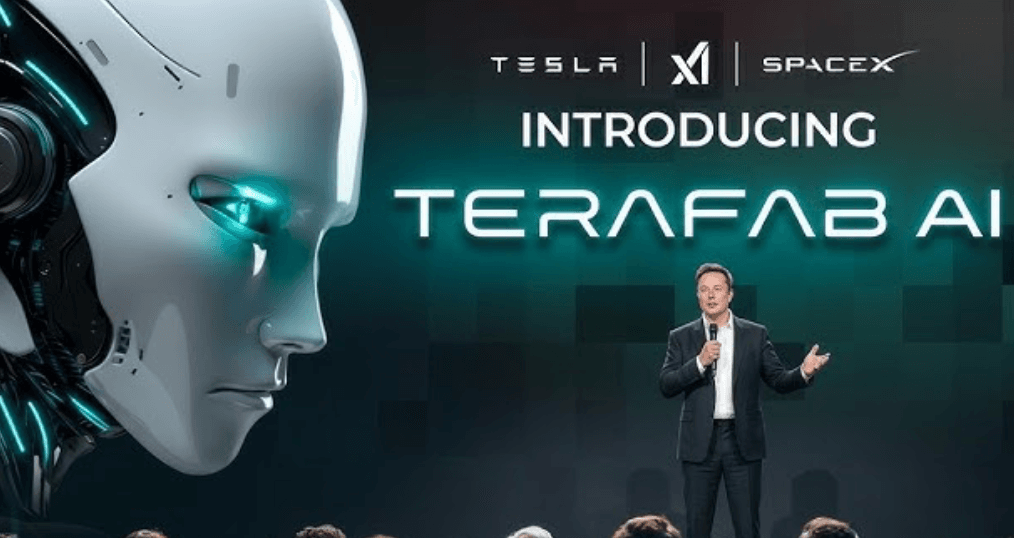
Elon Musk stood on stage at Austin’s defunct Seaholm Power Plant last night (March 21, 2026) and announced what he called “the most epic chip building exercise in history by far.”
Terafab: A $20-25 billion semiconductor fabrication facility that will produce 1 terawatt of computing power annually enough for 100-200 million AI chips per year.
The facility will be built at Tesla’s Giga Texas campus in Austin as a joint venture between Tesla, SpaceX, and xAI. It will house every stage of chip production under one roof: design, lithography, fabrication, memory, packaging, and testing. Target process node: 2-nanometer the most advanced commercial technology currently entering production.
The goal: vertical integration of Musk’s entire AI supply chain. From self-driving Teslas to Optimus humanoid robots to SpaceX’s orbital AI data centers to xAI’s Grok models all powered by chips made in-house.
The timeline: Musk announced “Terafab Project launches in 7 days” on March 14. Seven days later, Saturday night at 10:42 PM, he delivered the announcement. Construction hiring has already begun.
The reaction from tech industry analysts:
“This is Battery Day on steroids. And if you’ve been following how that turned out, you should be very skeptical.” — Electrek’s Fred Lambert
“Musk, who has no background in semiconductor production and a history of over-promising on goals and timelines…” — Bloomberg
“The chip fab won’t happen… it would take more money than he has, by a couple times. More relevant is that by the time he’d be making 2nm chips TSMC and others would be at a generation or two beyond.” — Electrek commentator
Let me explain what Terafab actually is, why Musk says it’s necessary, what the jaw-dropping scale entails, why skeptics think it’s pure fantasy, and whether this is visionary genius or delusional overreach.
What Terafab Actually Is: The Technical Vision
The Basics
Name: Terafab (short for “Terawatt Fabrication”)
Location: North Campus of Giga Texas, Austin (Eastern Travis County)
Companies involved: Tesla, SpaceX, xAI (joint venture)
Investment: $20-25 billion (though Tesla’s CFO acknowledged this isn’t yet in Tesla’s 2026 capex budget, which already exceeds $20 billion)
Goal: Produce 1 terawatt of compute annually = 100-200 million AI chips per year
Process technology: 2-nanometer node (cutting edge)
Scope: Vertically integrated every stage of chip production in one facility
What “Vertically Integrated” Means
Traditional chip production is fragmented:
- Design: One company (e.g., NVIDIA) designs the chip
- Fabrication: Another company (e.g., TSMC) manufactures it
- Packaging: Yet another company assembles dies into final chips
- Testing: Validation happens at multiple stages across facilities
Terafab’s approach: All stages happen in one building.
Musk’s claim: This enables a “continuous loop of testing and revising masks, a capability that doesn’t exist anywhere in the world.”
Why this matters (theoretically): Faster iteration. If you discover a design flaw during testing, you can immediately modify the photomask and rerun fabrication without shipping wafers between facilities.
The Scale: 1 Terawatt of Compute
What that means:
- 1 terawatt = 1 trillion watts of computing power
- Roughly equivalent to the total power generation capacity of the United States
- About 100-200 million AI chips annually
For context:
- TSMC (world’s largest foundry): Produces about 140-150 million chips annually across all customers
- Terafab at full scale: Would produce ~70% of TSMC’s total output from a single facility
Production targets:
- Phase 1: 100,000 wafer starts per month
- Full scale: 1 million wafer starts per month
The Timeline: Vague, As Always
Musk has not provided specific timelines for:
- When construction begins
- When first chips ship
- When full production is reached
- How long ramping takes
He said only that the project “launches” on March 21, 2026 which turned out to mean “announcing the project,” not breaking ground.
Historical pattern: Musk promises aggressive timelines, delivers years late (if at all).
Why Musk Says Terafab Is Necessary: The Chip Shortage Problem
Musk’s core argument: his companies need more chips than the entire semiconductor industry can supply.
The Demand Breakdown
Tesla:
- Full Self-Driving (FSD) computers for every vehicle
- Dojo supercomputers for training AI
- AI4/AI5 chips for next-gen vehicles
Optimus (humanoid robots):
- Musk claims Optimus alone will require 100-200 gigawatts of chips
- If Tesla produces tens of millions of robots (Musk’s goal), each needs significant onboard compute
xAI:
- Grok AI model training and inference
- Competing with OpenAI, Anthropic, Google requires massive compute
SpaceX:
- Orbital AI data centers (more on this insanity below)
- Starlink satellite processing
- Rocket guidance systems
Musk’s calculation: Current chip suppliers produce only about 2% of what he would need across all projects through 2030.
Why Existing Foundries Can’t Keep Up
Musk acknowledged that foundries like TSMC and Samsung (building a fab in Taylor, Texas) are expanding capacity. But he argues they’re not growing fast enough.
Quote from earnings call (January 28, 2026):
“Even in the best-case scenario for chip production from their suppliers, it still wouldn’t be enough.”
His claim: If he waited for TSMC/Samsung to scale to meet his needs, it would create a supply constraint that delays Tesla’s robotics ambitions by 3-4 years.
His solution: Build his own fab. “We’re gonna build Terafab.”
The Galactic Civilization Vision: Where This Gets Absurd
Here’s where Musk’s presentation went from “ambitious” to “completely detached from reality.”
The Space AI Compute Plan
Musk didn’t just announce an Earth-based chip fab. He announced orbital AI data centers.
The vision:
- Launch 100 million tons of solar capture equipment into space every year
- Deploy AI satellites powered by solar energy
- Run massive AI compute in orbit where cooling is free (vacuum of space)
- Scale to terawatts of compute in space
His justification: SpaceX recently acquired xAI in an all-stock deal. The combined entity wants to build AI infrastructure in orbit because:
- Solar power is more efficient in space (no atmosphere)
- Cooling is easier (radiate heat into vacuum)
- Land and power constraints disappear
His conclusion: “Orbital AI compute could become cheaper than terrestrial alternatives within 2-3 years.”
His proclamation: “We’re starting a galactic civilization. Eventually, we move beyond the moon, beyond Mars, and we sail through the rings of Saturn. In an economy a million times the size of Earth’s current output, if you can think of it, you can have it.”
The Reality Check
Let’s be very clear: 100 million tons of cargo to space per year is insane.
For context:
- SpaceX launched ~400 tons to orbit in all of 2025 (highest in history)
- 100 million tons = 250,000x current SpaceX capacity
- Even with Starship (120 tons per launch), that’s 833,000 launches per year
- That’s 2,283 launches per day
- Starship’s best case: maybe 100 launches per year by 2030
To launch 100 million tons annually would require fundamentally rewriting physics.
This is not “visionary.” This is delusional.
The Skepticism: Why Analysts Think Terafab Is Fantasy
Comparison to Battery Day (2020)
In September 2020, Musk unveiled Tesla’s 4680 battery cell at “Battery Day.”
The promises:
- Revolutionary dry electrode process
- 50% cost reduction
- Ramp to 10 GWh within a year
- Scale to 3 TWh by 2030 (enough for 20 million cars annually)
The reality (5.5 years later):
- Dry electrode process still doesn’t work at scale
- 4680 production is a fraction of targets
- Tesla still buys most batteries from suppliers (LG, CATL, Panasonic)
- The entire 4680 program has been a disappointment
Electrek’s Fred Lambert:
“This is Battery Day on steroids. And if you’ve been following how that turned out, you should be very skeptical.”
The Semiconductor Manufacturing Reality
Building a cutting-edge chip fab is extraordinarily difficult and expensive.
TSMC’s experience:
- Decades of accumulated expertise
- Hundreds of billions in R&D investment
- Thousands of specialized engineers
- Complex supply chains for materials and equipment
- Years to ramp each new process node
Samsung’s Taylor, Texas fab:
- Announced 2021
- $17 billion investment
- Still not in full production in 2026
- Struggling with yield issues on advanced nodes
Intel’s struggles:
- Spent $100+ billion trying to regain process leadership
- Still trails TSMC by 1-2 generations
- 18A node (Intel’s 1.8nm) facing delays and yield problems
Musk’s plan: Build a 2nm fab from scratch, scale to 70% of TSMC’s total output, with no prior semiconductor manufacturing experience.
Tom’s Hardware reader comment:
“The chip fab won’t happen… It would take longer than Musk has left on this planet to get it operational at the level he’s promising and it would take more money than he has, by a couple times. More relevant is that by the time he’d be making 2nm chips TSMC and others would be at a generation or two beyond.”
The Timing Problem
2nm process technology:
- TSMC is just now beginning 2nm production (2026)
- It took TSMC decades and $100+ billion to get there
- By the time Terafab could theoretically produce 2nm chips (2030s?), TSMC will be on 1nm or beyond
The “skating to where the puck will be” problem:
“Musk is claiming to be a leader but in so many things he’s still lacing up his skates.” — Electrek commenter
The Capital Problem
Estimated cost: $20-25 billion
Tesla’s acknowledgment: This is not yet included in Tesla’s 2026 capex plan (already >$20 billion).
Tesla’s 2025 net income: ~$18 billion
SpaceX finances: Private, but estimated annual revenue ~$15 billion
The math: Even if Tesla and SpaceX combined all their profits, $20-25 billion is a massive capital commitment that would require debt financing or equity raises diluting shareholders.
Competing priorities: Tesla is also building:
- Cybercab production lines
- Optimus robot factories
- Dojo supercomputer clusters
- Solar manufacturing facilities (another $2.9 billion announced recently)
Where is the money coming from for all of this?
What’s Actually Happening Right Now
Despite the grandiose vision, actual progress is minimal:
Hiring Announcement (March 19, 2026)
Tesla posted a job listing: “Semiconductor Fabs Construction Manager”
Responsibilities:
- Plan and oversee construction of semiconductor fabrication facilities
- Coordinate with architects, engineers, contractors
- Ensure compliance with industry standards
This is step 1: Hire someone to figure out how to build a fab.
Not announced:
- Equipment purchases
- Facility design
- Partnerships with semiconductor equipment suppliers (ASML, Applied Materials, Lam Research)
- Process technology licensing agreements
- Hiring of fab engineers and technicians
No Details on Key Questions
Where exactly? “North Campus of Giga Texas” is vague. No specific site announced.
When does construction begin? Not specified.
Who are the partners? Chip fabs require equipment from ASML (EUV lithography), Applied Materials, Lam Research, etc. No partnerships announced.
What about yields? Even TSMC and Samsung struggle with yields on new nodes. How will a first-time fab achieve competitive yields?
What about talent? Semiconductor manufacturing requires thousands of specialized engineers. Where will Tesla/SpaceX find them?
The Bottom Line: Vision or Vaporware?
There are two ways to interpret Terafab:
The Optimistic Interpretation
Musk has a track record of achieving seemingly impossible goals:
- SpaceX made reusable rockets viable (experts said impossible)
- Tesla made EVs mainstream (legacy auto said unworkable)
- Starlink deployed global satellite internet (telecom said impractical)
Maybe Terafab is another moonshot that succeeds through sheer force of will, capital, and engineering talent.
Believers point to:
- Musk’s willingness to invest billions in long-term projects
- Tesla/SpaceX’s ability to attract top engineering talent
- Vertical integration advantages if it works
The Pessimistic Interpretation
Musk has an equally long track record of overpromising and underdelivering:
- Full Self-Driving “next year” for 8+ years running
- Cybertruck delays, production issues, quality problems
- 4680 battery cell failure to meet targets
- Solar roof tile production never scaling
- Hyperloop and Boring Company going nowhere
- Neuralink human trials delayed repeatedly
Skeptics point to:
- No semiconductor manufacturing experience
- Unrealistic timelines
- Unclear capital sources
- 2nm technology already obsolete by the time Terafab could produce it
- “Galactic civilization” rhetoric suggests detachment from reality
My Assessment
Terafab will be announced. Construction may even begin. Musk will hire engineers, purchase some equipment, and build something at Giga Texas.
But the vision described Saturday night 1 terawatt of compute, 100-200 million chips annually, 2nm at scale, orbital AI data centers will not happen as described.
More likely: Tesla builds a small-scale fab focused on specific chips for internal use (FSD computers, Dojo components). Maybe 10,000-50,000 wafer starts per month at older process nodes (7nm, 5nm). Useful for Tesla, but nowhere near the “epic chip building exercise in history” Musk promised.
The orbital AI compute vision is pure fantasy. 100 million tons to space annually is thermodynamically impossible with current or foreseeable propulsion technology.
The “galactic civilization” rhetoric is Musk at his most untethered selling a sci-fi vision to excite investors and fans while distracting from the very real challenges his companies face (Tesla sales declining, Cybertruck quality issues, FSD lawsuits mounting).
If you’re skeptical, you should be. Musk’s promises deserve scrutiny, not blind faith.
If you’re optimistic, temper expectations. Even if Terafab succeeds, it will be smaller, slower, and more expensive than announced. And that’s okay a successful small-scale fab would still be impressive.
Just don’t expect 1 terawatt of compute or AI data centers orbiting Saturn.
Terafab announced March 21, 2026 at Seaholm Power Plant, Austin. Joint venture: Tesla, SpaceX, xAI. Estimated cost: $20-25 billion. Location: Giga Texas North Campus. Timeline: unspecified. First hiring: Semiconductor Fabs Construction Manager position posted March 19, 2026. No construction start date announced. For updates, follow Tesla investor relations and Elon Musk’s X account (@elonmusk).
Leave a Reply