
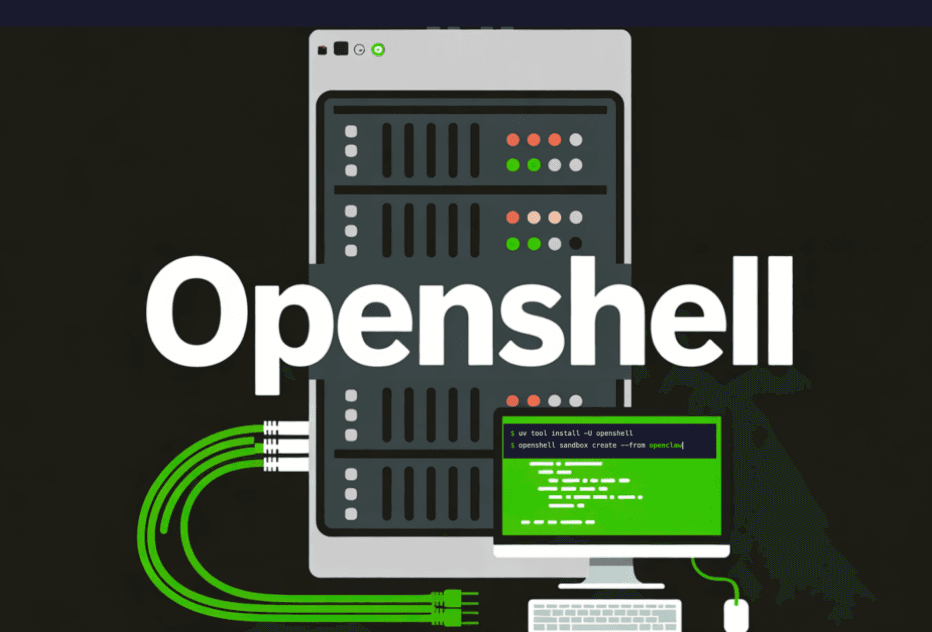
NVIDIA just announced OpenShell at GTC 2026, and it might be the most important piece of AI infrastructure nobody’s talking about.
Not another chatbot. Not another GPU. Not another model. OpenShell is something fundamentally different: an open-source secure runtime that makes autonomous AI agents safe enough for enterprises to actually deploy.
“OpenShell provides the missing infrastructure layer beneath claws to give them the access they need to be productive while enforcing policy-based security, network and privacy guardrails,” said Kari Briski, VP of Generative AI at NVIDIA.
Translation: AI agents want to run wild across your systems, accessing files, executing code, and communicating externally. OpenShell is the cage that keeps them from destroying everything.
Announced March 16, 2026 during Jensen Huang’s GTC keynote, OpenShell is NVIDIA’s answer to the fundamental problem blocking enterprise AI agent adoption: trust. Specifically, how do you trust an autonomous AI system with access to sensitive data, critical systems, and external communication when that AI could:
- Leak confidential documents to competitors
- Delete critical files through misinterpretation
- Execute malicious code it found online
- Share private information with unauthorized parties
OpenShell solves this through sandboxing, least-privilege access controls, policy-based network guardrails, and a privacy router that prevents internal data from leaking externally even when agents use cloud-based models.
Let me explain what OpenShell actually is, how it works, why NVIDIA built it, what it enables, and why this might be the infrastructure layer that makes autonomous AI agents viable for enterprise deployment.
The Problem OpenShell Solves: AI Agents Are Powerful But Unsafe
What AI Agents Do
Autonomous AI agents “claws” in the emerging terminology don’t just answer questions. They act on your behalf across digital systems:
- Read and send emails autonomously
- Browse the web for research
- Access and modify files
- Write and execute code
- Manage databases
- Initiate transactions
- Coordinate across multiple applications
OpenClaw, the viral open-source AI agent platform that became “the fastest-growing open source project in history” after launching in January 2026, demonstrates what’s possible. Within weeks, it surpassed Linux’s 30-year adoption in just three weeks.
The Security Nightmare
But OpenClaw has a massive problem that blocked enterprise adoption: it has no security controls.
As Jensen Huang acknowledged in his GTC keynote:
“Systems in the corporate network can have access to sensitive information, it can execute code, and it can communicate externally. Just say that out loud. Think about it: Access sensitive information, execute code, communicate externally. You can access employee information, access the supply chain, access finance information, sensitive information, and send it out, communicate externally.”
Without guardrails:
- Agents could exfiltrate proprietary data
- Misconfigured agents could delete critical files
- Agents could escalate privileges beyond their intended scope
- No audit trail of what agents actually did
- No way to define what agents are allowed to access
Gartner’s December 2025 report warned that “governance platforms for AI agents would be the crucial infrastructure needed for enterprises to adopt the AI tech.”
NVIDIA listened. OpenShell is that governance platform.
What OpenShell Actually Is: The Technical Architecture
OpenShell is a secure runtime environment for AI agents, providing:
1. Process-Level Isolation (Sandboxing)
What it does: Each AI agent runs in its own isolated environment, separated from other agents and the host system.
Why it matters: If one agent malfunctions or gets compromised, it can’t affect other agents or access data outside its sandbox.
How it works: OpenShell uses containerization and process isolation to create walled environments. Agents see only what they’re explicitly given permission to access.
2. Least-Privilege Access Controls
What it does: Agents get the minimum permissions needed to complete their tasks, nothing more.
Why it matters: Traditional systems often grant broad access (“admin privileges”). With AI agents executing autonomously, that’s catastrophically dangerous.
How it works: Administrators define fine-grained permissions:
- Which files/folders agents can read
- Which files/folders agents can modify
- Which external services agents can call
- Which code agents can execute
Configuration: Policies defined via YAML files with hot-swappable rules adjust constraints without redeploying agents.
3. Policy-Based Network Guardrails
What it does: Controls what external communication agents can initiate.
Why it matters: Prevents data exfiltration. An agent might try to send your confidential documents to external services either maliciously or through misinterpretation.
How it works: Network policies specify:
- Approved external domains agents can contact
- Blocked domains (competitors, known malicious sites)
- Data that can never leave the network
- Approval requirements for external communication
4. The Privacy Router (The Game-Changer)
What it does: Enables agents to use powerful cloud-based AI models (GPT-4, Claude Opus, Gemini Pro) while keeping your private data local.
Why it matters: Frontier AI models in the cloud are more capable than local models, but sending your data to external services creates privacy/compliance risks.
How the Privacy Router works:
- Agent needs to process sensitive data using a cloud model
- Privacy Router intercepts the request
- Router uses differential privacy technology (acquired from Gretel) to strip personally identifiable information
- Sanitized query sent to cloud model
- Result returned to agent
- Original sensitive data never leaves your system
Example:
- Agent wants to analyze: “Analyze customer complaints for Sarah Johnson (SSN: 123-45-6789) regarding Product X”
- Privacy Router sends: “Analyze customer complaints for [CUSTOMER] regarding [PRODUCT]”
- Cloud model processes anonymized query
- Result returned with insights, but Sarah Johnson’s identity never left your network
This is breakthrough technology. It lets enterprises use the most powerful AI models without exposing sensitive data.
NemoClaw: OpenShell + OpenClaw + Nemotron Models
NVIDIA didn’t just release OpenShell as a standalone tool. They packaged it with OpenClaw and their Nemotron AI models as NemoClaw a complete, enterprise-ready AI agent stack.
The NemoClaw Stack:
OpenClaw: The agent platform (open-source, community-developed) OpenShell: The security/privacy runtime (NVIDIA’s contribution) Nemotron models: NVIDIA’s open AI models optimized for agentic tasks
Installation: Single command deploys the entire stack
Philosophy: “OpenClaw is the AI worker. OpenShell is the walled environment in which that worker operates.”
How NemoClaw Works:
Local processing: Agents can use Nemotron models running entirely on your hardware (no cloud dependency)
Hybrid processing: Agents can also access cloud frontier models (GPT-4, Claude, etc.) via the Privacy Router
Flexibility: Use open models for sensitive tasks, cloud models for complex tasks requiring maximum capability
Hardware agnostic: Runs on any dedicated platform:
- GeForce RTX PCs and laptops
- RTX PRO workstations
- DGX Station and DGX Spark AI supercomputers
- Does not require NVIDIA hardware (unlike many NVIDIA software stacks)
The Enterprise Security Partnerships
NVIDIA isn’t building OpenShell in isolation. They’re collaborating with major security vendors to ensure compatibility with existing enterprise security infrastructure:
Security partners:
- CrowdStrike: Endpoint detection and response
- Cisco: Network security and access control
- Google Security: Cloud security integration
- Microsoft Security: Azure and M365 security
- TrendAI: AI-specific threat detection
Goal: OpenShell integrates with tools enterprises already use, not requiring complete security stack replacement.
Enterprise Software Integration
NVIDIA is positioning NemoClaw as infrastructure beneath enterprise software, not competition with it:
Confirmed integrations:
- Salesforce: AI agents for CRM automation
- SAP: Enterprise resource planning workflows
- ServiceNow: IT service management automation
- Adobe: Creative workflow automation
- Dell: Hardware deployment and agent infrastructure
Jensen Huang: “The policy engines of all the SaaS companies in the world [can connect]. NemoClaw or OpenClaw with OpenShell would be able to execute that policy engine.”
Real-World Use Cases: What OpenShell Enables
Let’s get concrete about what becomes possible with OpenShell’s security/privacy guarantees:
Use Case 1: Autonomous Customer Service
Without OpenShell: Too risky. Agents might leak customer data, access unauthorized systems, send inappropriate responses.
With OpenShell:
- Agent accesses only designated customer service databases
- Cannot read employee records or financial data
- Requires approval before sending communications to customers
- All actions logged and auditable
- Privacy Router ensures customer PII never goes to cloud models
Use Case 2: Financial Analysis and Reporting
Without OpenShell: Compliance nightmare. Financial data leaving the network violates regulations.
With OpenShell:
- Agent processes financial data entirely locally using Nemotron models
- If cloud processing needed, Privacy Router strips identifiable information
- Network guardrails prevent data transmission to unauthorized destinations
- Least-privilege access means agents see only relevant financial segments
Use Case 3: Code Generation and Software Development
Without OpenShell: Security disaster. Agent could execute malicious code, access production systems, leak proprietary source code.
With OpenShell:
- Agent sandboxed to development environments only
- Cannot access production databases or systems
- Code execution limited to designated testing environments
- All external package downloads require approval
- Source code never sent to external services without sanitization
Use Case 4: Research and Competitive Intelligence
Without OpenShell: Agents might share internal research with competitors or public services.
With OpenShell:
- Agent can browse web for competitive intelligence
- Internal research documents accessible only within sandbox
- Privacy Router ensures queries to cloud services contain no proprietary information
- Network guardrails prevent accidental data exfiltration
The AI-Q Blueprint: How OpenShell Powers Advanced Workflows
NVIDIA also announced AI-Q (AIQ), an open agent blueprint for enterprise deep research that uses OpenShell infrastructure.
What AI-Q Does:
Combines frontier models (GPT-4, Claude Opus) for orchestration with NVIDIA Nemotron models for research tasks.
Architecture:
- Frontier model decides overall strategy and task decomposition
- Nemotron models execute specific research subtasks
- Results synthesized by frontier model
Performance:
- Top-ranking on Deep Research Bench I and II leaderboards
- 50%+ cost reduction vs. using frontier models for everything
- “World-class accuracy” according to NVIDIA
Why this matters: Proves that OpenShell’s hybrid local/cloud approach works at production scale. You get frontier-model intelligence with open-model economics and security.
The Governance Question: Who Controls Your AI Agents?
OpenShell raises a fundamental question about AI agent governance:
The Traditional Model: You Control Your Computer
With traditional software, you decide what runs, when, with what permissions. You’re in complete control.
The Cloud Model: Platform Controls Your AI
With cloud AI (ChatGPT, Claude, Gemini), you send queries to someone else’s servers. They control the models, the infrastructure, the data.
The OpenShell Model: Delegated Control With Guardrails
With OpenShell, you define policies. Agents operate autonomously within those constraints. You’re not controlling every action, but you’ve defined the boundaries.
This is a new paradigm: Neither full manual control nor complete cloud dependence. It’s policy-driven autonomous operation.
The question: Are enterprises comfortable with this middle ground? Can they trust policy definitions to prevent all failure modes?
The Limitations: What OpenShell Doesn’t Solve
To be balanced, let’s address what OpenShell can’t fix:
Limitation 1: Agents Still Make Mistakes
OpenShell prevents unauthorized access and data leaks. It doesn’t make agents smarter or prevent them from misinterpreting instructions.
Example: If you tell an agent “clean up old files” and it deletes something important, OpenShell won’t stop that—it’s within the agent’s authorized permissions.
Limitation 2: Policy Configuration Is Hard
Defining correct security policies requires deep understanding of:
- What agents need to access
- What could go wrong
- How to balance security vs. functionality
Risk: Overly restrictive policies render agents useless. Overly permissive policies defeat the security purpose.
Limitation 3: Not Production-Ready Yet
NVIDIA explicitly states: “NemoClaw is an early-stage alpha release. Expect rough edges. We are building toward production-ready sandbox orchestration.”
Translation: Don’t deploy this in critical production systems yet. It’s for experimentation and early adoption.
Limitation 4: Doesn’t Solve the “Who’s Responsible” Question
When an AI agent operating within OpenShell’s guardrails makes a mistake that costs money or leaks data who’s liable?
- The enterprise that deployed it?
- NVIDIA that built OpenShell?
- The OpenClaw community?
- The agent’s developer?
This remains legally undefined.
The Bottom Line: OpenShell Makes AI Agents Viable (Maybe)
Here’s what NVIDIA accomplished with OpenShell:
Before OpenShell:
- AI agents too risky for enterprise deployment
- Security concerns blocked adoption
- No way to enforce policies or prevent data leaks
- Choice between powerful-but-unsafe or safe-but-weak
With OpenShell:
- Sandboxed environments isolate agents
- Least-privilege access limits damage potential
- Privacy Router enables cloud model use without data exposure
- Policy-based controls enforceable programmatically
- Audit trails provide accountability
The result: Enterprises can actually consider deploying autonomous AI agents for real workflows, not just demos.
Will they adopt it?
Jensen Huang thinks so: “For the CEOs, the question is, what’s your OpenClaw strategy? We all have a Linux strategy. We all needed to have an HTTP HTML strategy, which started the internet. We all needed to have a Kubernetes strategy, which made it possible for mobile cloud to happen.”
His argument: OpenShell + OpenClaw is as foundational to the AI agent era as Linux was to cloud computing, HTML to the web, or Kubernetes to containerization.
Is he right?
The optimistic case: OpenShell solves the trust problem that blocked enterprise AI agent adoption. Within 2-3 years, autonomous agents become standard in enterprises, and OpenShell is the infrastructure layer that made it possible.
The skeptical case: Enterprise IT is extremely conservative. Even with OpenShell, legal, compliance, and procurement teams will be reluctant to deploy autonomous agents accessing sensitive data. Adoption happens slowly, if at all.
My prediction: OpenShell won’t be the single answer, but it’s a critical enabling technology. Enterprises will deploy agents in limited, controlled environments first (customer service, research, development). As confidence builds, usage expands. By 2028-2029, autonomous agents become common and OpenShell or something like it will be the infrastructure making that possible.
For now: OpenShell is in early alpha. Developers and enterprises can experiment with NemoClaw, but production deployment is premature.
But for the first time, there’s a credible answer to “how do we make AI agents safe enough to actually use?”
And that’s progress.
NVIDIA OpenShell is available now as part of NemoClaw (early alpha). Installation via single command. Supports OpenClaw agents with Nemotron models and privacy/security guardrails. Hardware agnostic (doesn’t require NVIDIA GPUs). Enterprise partnerships with CrowdStrike, Cisco, Google, Microsoft Security, Salesforce, SAP, ServiceNow, Adobe, Dell. For documentation and downloads, visit developer.nvidia.com/nemoclaw. Production-ready releases expected throughout 2026.
Leave a Reply