
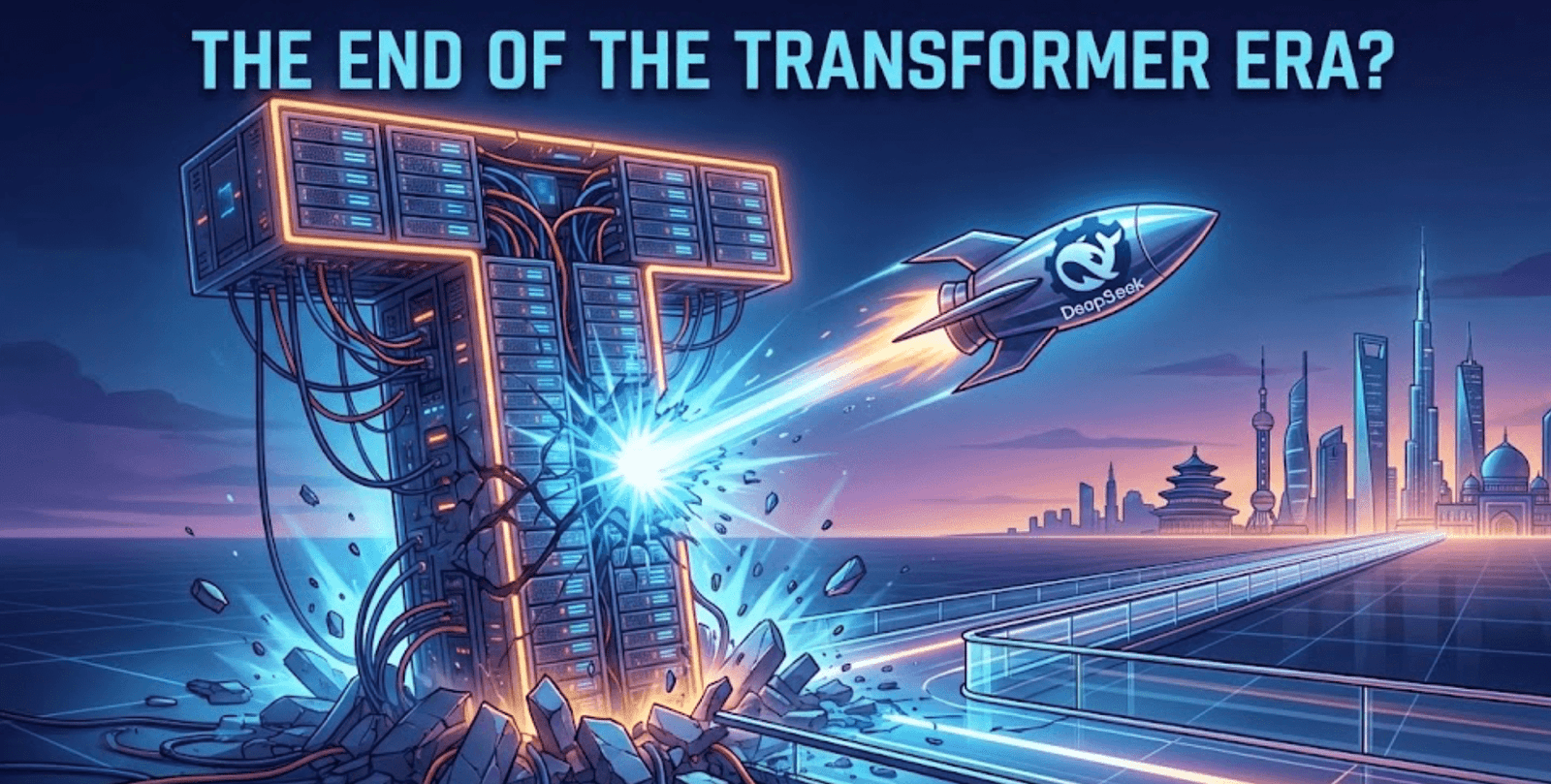
For the last three years, the entire artificial intelligence industry has been worshipping at the altar of one specific architecture: The Transformer.
It’s the “T” in GPT. It’s the engine under the hood of Gemini, Claude, and Llama. It’s the reason AI went from “neat parlor trick” to “civilizational shift” overnight. The Transformer’s ability to pay attention to everything in a sentence all at once was a massive breakthrough.
But in early 2026, an uncomfortable truth is settling over Silicon Valley: The Transformer is getting fat, slow, and impossibly expensive to scale. We are hitting a wall of diminishing returns, where making the models bigger requires exponentially more power for only incremental gains in smarts.
Enter DeepSeek.
If you haven’t been paying attention to this Chinese AI lab, you should be. They are the “dark horse” that keeps humiliating Western tech giants by releasing open-source models that match GPT-4’s performance at a fraction of the training cost. They are the masters of efficiency.
And this week, DeepSeek dropped a series of technical hints and research notes that have engineers across the globe sitting up straight. They aren’t just trying to build a better Transformer.
They are preparing to kill it.
The Problem with “All-Hands Meetings”
To understand why DeepSeek’s hints are so important, you need to understand the fundamental flaw of the Transformer architecture.
Imagine a company with 10 employees. If they have an “all-hands meeting” where everyone talks to everyone else to solve a problem, it’s efficient.
Now imagine a company with 100 billion “employees” (parameters). If you force every single one of them to pay attention to every single other one simultaneously for every task, you get chaos. It requires massive amounts of compute memory and energy.
That is essentially how a Transformer works. Its “attention mechanism” scales quadratically. It’s brilliant, but it’s a brute-force approach that is fast becoming unsustainable. We are running out of GPUs and power plants to feed these beasts.
The DeepSeek Pivot: Elegance over Brute Force
DeepSeek has always been obsessed with doing more with less. They were early pioneers of Mixture of Experts (MoE) a technique where, instead of using the whole brain for every task, the model only activates the relevant “experts.” (Think of it as only calling the marketing department when you have a marketing question, rather than waking up the whole company).
But their latest hints suggest they are going much further than just MoE.
Based on recent papers and GitHub activity, DeepSeek appears to be heavily researching hybrid architectures that move away from pure attention mechanisms. They are looking at alternatives like State-Space Models (SSMs), similar to the “Mamba” architecture that made waves in research circles last year.
Why does this matter? Unlike Transformers, these new architectures don’t require the “all-hands meeting.” They process information more like a highly efficient conveyor belt. They scale linearly, not quadratically.
If DeepSeek solves the puzzle of making these new architectures as smart as Transformers, but with linear scaling efficiency, the implications are massive:
1. The Context Window Explosion
Right now, giving an AI a whole book to read is expensive and slow because the Transformer has to “attend” to every word simultaneously. A post-Transformer architecture could theoretically handle infinite context windows without choking. Imagine an AI that can read your company’s entire 20-year history and instantly answer questions about it, running on a single server.
2. AI Leaves the Data Center
This is the holy grail. Transformers are too heavy to run well on your phone or laptop. They need the cloud. A highly efficient, linear architecture could finally bring true, GPT-4-level intelligence directly onto your device, running locally without killing your battery in an hour. This ties directly into the rise of “edge AI” hardware we saw at CES this year.
3. The Geopolitical Shift
Until now, the West has led on architecture innovation (thanks to Google inventing the Transformer), while China has excelled at application and efficiency. If DeepSeek defines the next foundational architecture standard, it represents a major shift in the technological balance of power.
The Verdict: The Great Rethink
We are leaving the “bigger is better” phase of AI and entering the “smarter is better” phase.
For three years, the strategy has been to just throw more GPUs at the problem. That era is ending, constrained by physics and economics. The next trillion dollars in AI value won’t be unlocked by making the models larger; it will be unlocked by making the architecture infinitely scalable.
DeepSeek has a track record of spotting efficiency trends before anyone else. If they are signaling that it’s time to move beyond the Transformer, the rest of the industry had better pay attention. The “T” had a great run, but the future might belong to a different letter entirely.
What do you think? Are we ready to move past the architecture that built ChatGPT, or is the Transformer still got life left in it?