
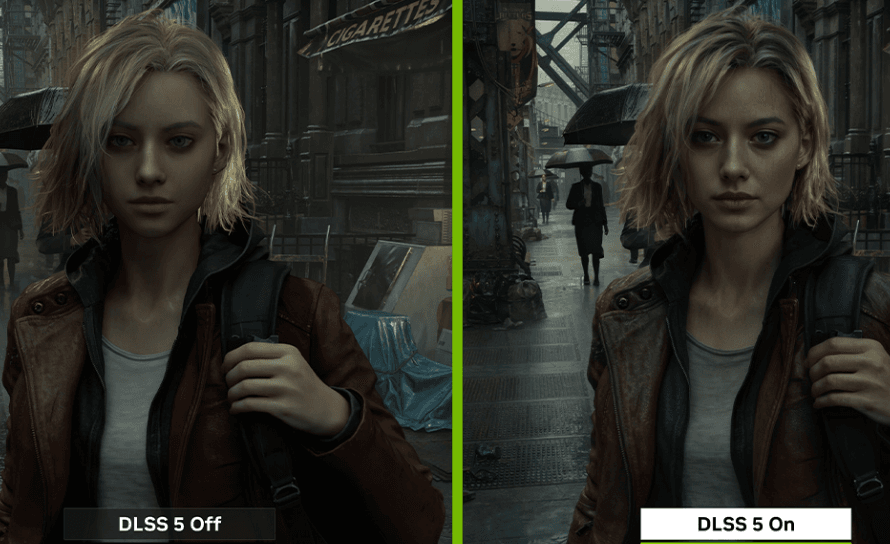
NVIDIA just announced DLSS 5 at GTC 2026, calling it “the most significant breakthrough in computer graphics since the debut of real-time ray tracing in 2018.”
The gaming community’s response? Immediate, visceral backlash.
Within hours of the reveal, Reddit threads exploded with criticism. Bluesky users called it “AI slop.” TechRadar quoted a user saying “I thought this video was an April Fool’s joke, but it’s still March.” The internet invented a new game: creating DLSS acronyms featuring the word “slop.”
When Tom’s Hardware asked NVIDIA CEO Jensen Huang about the criticism at a GTC press Q&A, his response was blunt:
“Well, first of all, they’re completely wrong.”
Welcome to DLSS 5 NVIDIA’s attempt to use AI neural rendering to make games look photorealistic. And welcome to the controversy about whether AI should be “improving” graphics at all, or whether we’re watching game visuals get homogenized into a single AI-generated aesthetic that nobody asked for.
DLSS 5 launches Fall 2026 for RTX 50-series GPUs. Major publishers Bethesda, CAPCOM, Ubisoft, Warner Bros., Tencent—have already committed. Games like Starfield, Assassin’s Creed Shadows, Hogwarts Legacy, and Resident Evil Requiem will support it at launch.
Let me explain what DLSS 5 actually does, why it’s fundamentally different from previous DLSS versions, what the controversy is really about, and whether Jensen Huang is right that gamers are “completely wrong” or whether NVIDIA just fundamentally misunderstood what gamers want.
What DLSS 5 Actually Is: Neural Rendering, Not Upscaling
First, let’s clarify what changed. DLSS 5 is NOT the same technology as DLSS 4.5.
DLSS 1-4.5: Performance Technology
What it did:
- DLSS 1-3: AI upscaling (render at lower resolution, use AI to reconstruct higher resolution)
- DLSS 3-4: Frame generation (AI creates entirely new frames between rendered frames)
- DLSS 4.5: Multi-frame generation (AI generates up to 23 out of every 24 pixels displayed)
Goal: Boost frame rates and performance while maintaining visual quality
Trade-off: Some visual artifacts, input latency, but massively higher FPS
Gamer reaction: Generally positive. “I can run ray tracing at 144fps now? Amazing.”
DLSS 5: Visual Fidelity Technology
What it does:
- Takes game’s existing color and motion vectors as input
- Uses AI neural rendering model to “infuse pixels with photoreal lighting and materials”
- Generates entirely new visual appearance based on what AI thinks looks “photoreal”
Goal: Make games look like Hollywood CGI, not boost performance
Trade-off: Games look different than the developer designed them
Gamer reaction: “Wait, you’re using AI to replace the artists’ work? No thanks.”
How DLSS 5 Actually Works: The Technical Details
NVIDIA’s description:
“DLSS 5 takes a game’s color and motion vectors for each frame as input, and uses an AI model to infuse the scene with photoreal lighting and materials that are anchored to source 3D content and consistent from frame to frame.”
In plain English:
- Game renders a frame normally (characters, environments, lighting)
- DLSS 5’s AI model analyzes the frame
- AI identifies scene elements: skin, hair, fabric, metal, wood, etc.
- AI applies what it has learned “photoreal” versions of those materials should look like
- AI generates enhanced lighting: subsurface scattering on skin, fabric sheen, hair light interactions
- Final frame is displayed—same geometry, but AI-generated materials and lighting
The training:
The AI model is trained end-to-end on massive datasets to understand:
- Complex scene semantics (characters, hair, fabric, translucent skin)
- Environmental lighting (front-lit, back-lit, overcast, indoor, outdoor)
- Material properties (how light interacts with different surfaces)
The claim:
AI can analyze a single frame and generate Hollywood-quality lighting and materials in real-time at 4K resolution.
What DLSS 5 Changes: The Before/After Examples
NVIDIA showcased DLSS 5 in five games at GTC:
Hogwarts Legacy
DLSS 5 off: Standard ray-traced lighting DLSS 5 on:
- Rim lighting around edges of students’ hair and clothing near sunlit windows
- Improved ambient occlusion in every fold of robes
- Better darkening in corners and crannies of Hogwarts castle
Tom’s Hardware assessment: “Even in games that already feature real time ray-traced effects… DLSS 5 on and off creates even more convincing lighting effects.”
Starfield
DLSS 5 off: No ray tracing (game never implemented it) DLSS 5 on:
- “Considerably greater sophistication to the appearance of environments and objects”
- Enhanced character faces
- Better material definition
Tom’s Hardware assessment: “Those improvements carry over to games like Starfield that never implemented ray tracing to begin with.”
Resident Evil Requiem
DLSS 5 off: CAPCOM’s native character models (Grace Ashcroft, Leon Kennedy) DLSS 5 on: AI-enhanced versions with “photoreal” skin, hair, and lighting
Community reaction: This is where the backlash exploded. Critics say the characters look worse—over-processed, “AI slop,” homogenized.
Assassin’s Creed Shadows
DLSS 5 off: Already impressive ray-traced implementation DLSS 5 on: “Makes the light and shadow playing across the game’s forested vistas appear even closer to life”
EA SPORTS FC (FIFA)
DLSS 5 off: EA’s player models DLSS 5 on: Enhanced player faces and materials
The Controversy: Why Gamers Are Furious
The backlash isn’t about the technology failing. It’s about what the technology is trying to do.
Criticism 1: “This Is AI Slop”
The argument: DLSS 5 makes everything look like generic AI-generated imagery. Over-processed. Over-smoothed. Bloom and halo effects everywhere. The distinctive art style of each game gets replaced with a single homogenized “AI photoreal” aesthetic.
Lowyat.NET:
“While the final output certainly looks more detailed, they all look like something you’d get from a Generative AI tool. That includes the bloom and halo effects around characters, main and NPCs, the textures of other assets in the world, and even the background.”
The deeper issue: AI models are trained on datasets that reflect a particular aesthetic. When DLSS 5 “enhances” visuals, it’s imposing that aesthetic onto games whether or not it matches the developer’s artistic intent.
Criticism 2: “Artists Spent Years Creating This Look”
The argument: Game developers employ hundreds of artists who painstakingly design lighting, materials, character models. DLSS 5 uses AI to override that work, replacing human artistic choices with what an algorithm thinks “photoreal” should look like.
Resident Evil example: CAPCOM’s character artists designed Grace Ashcroft and Leon Kennedy with specific appearances. DLSS 5 changes them. Maybe the AI version is more “photoreal,” but is it what CAPCOM wanted?
Jensen Huang’s response:
“All of that is in the control direct control of the game developer. Developers can try the tool and see how they want to use it.”
Counter-response: If developers have “direct control,” why are we seeing examples where DLSS 5 fundamentally changes character appearances? Either developers approved these changes (and gamers hate them), or developers don’thave as much control as Jensen claims.
Criticism 3: “Not Everything Should Be Photoreal”
The argument: Games have art styles. Stylized visuals. Cartoonish characters. Exaggerated proportions. Not everything should look like a Hollywood CGI movie.
Examples:
- Zelda: Breath of the Wild/Tears of the Kingdom cel-shaded, painterly aesthetic
- Persona 5 bold colors, anime-inspired art direction
- Hollow Knight hand-drawn, atmospheric
- Cuphead 1930s cartoon aesthetic
DLSS 5’s “photoreal” enhancements would destroy these art styles.
NVIDIA’s answer: Developers can control intensity, masking, and where DLSS 5 is applied.
Gamer skepticism: Will developers actually take time to configure DLSS 5 properly for their art style, or will they just flip it on with default settings?
Criticism 4: “This Is Just Nvidia’s View of Reality”
The argument: “Photoreal” isn’t objective. It’s whatever the AI model was trained to think looks photoreal. And that training data reflects NVIDIA’s choices, biases, and aesthetic preferences.
When DLSS 5 changes how characters and environments look, it’s imposing NVIDIA’s version of reality onto games.
Jensen Huang’s response:
“They’re completely wrong. The reason for that is because… DLSS 5 fuses controllability of geometry and textures and everything about the game with generative AI. This is very different than generative AI; it’s content-control generative AI.”
Translation: We’re not replacing your game with AI-generated content. We’re enhancing what’s already there using AI that understands your content.
Gamer translation: That’s a semantic distinction. You’re still using AI to change how our games look, whether you call it “content-control generative AI” or just “generative AI.”
The Defense: Why Some Experts Think DLSS 5 Is Revolutionary
Not everyone hates DLSS 5. Tech reviewers who saw it in person at GTC were impressed.
Tom’s Hardware (Hands-On Preview):
“For modern games with assets built to match, DLSS 5 unquestionably improved the image quality and fidelity of the small group of titles we saw.”
“Even in games that already feature real time ray-traced effects, like Hogwarts Legacy, flipping DLSS 5 on and off creates even more convincing lighting effects.”
The Technical Achievement Argument
The claim: Native rendering can’t deliver Hollywood-quality visuals in real-time, even on the $2,000 RTX 5090. The 575W, ~750mm² GPU isn’t powerful enough to shade every pixel to cinematic quality.
AI offers an alternate path: instead of brute-force compute scaling (bigger GPUs, more power), use neural networks to intelligently infer what scenes should look like.
Jensen Huang:
“Twenty-five years after NVIDIA invented the programmable shader, we are reinventing computer graphics once again. DLSS 5 is the GPT moment for graphics blending handcrafted rendering with generative AI to deliver a dramatic leap in visual realism while preserving the control artists need for creative expression.”
The Ray Tracing Parallel
When NVIDIA introduced real-time ray tracing in 2018, gamers initially complained:
- “It’s too demanding”
- “Frame rates tank”
- “The visual improvement isn’t worth the performance cost”
Today, ray tracing is standard in AAA games. Opinions changed.
NVIDIA’s bet: DLSS 5 backlash will follow the same trajectory. Initial resistance → gradual acceptance → eventually becomes the standard.
The Developer Perspective: Who’s Actually Supporting This
NVIDIA announced support from major publishers and developers:
- Bethesda (Starfield, The Elder Scrolls IV: Oblivion Remastered)
- CAPCOM (Resident Evil Requiem)
- Ubisoft (Assassin’s Creed Shadows)
- Warner Bros. Games (Hogwarts Legacy)
- Hotta Studio
- NetEase (NARAKA: BLADEPOINT)
- NCSOFT
- S-GAME
- Tencent (Delta Force)
Todd Howard (Bethesda):
“NVIDIA and Bethesda have a long history of pushing gaming graphics and innovation forward, and DLSS 5 represents the next major step in that journey. With DLSS 5 the artistic style and detail shine through without being held back by the traditional limits of real-time rendering.”
Jun Takeuchi (CAPCOM):
“At CAPCOM, we strive to create experiences that feel cinematic, compelling and deeply believable — where every shadow, texture and ray of light is crafted with intention to enhance atmosphere and emotional impact.”
The question: Are these developers genuinely excited about DLSS 5’s artistic possibilities, or are they issuing PR statements because NVIDIA is a major partner?
We’ll know when games actually launch and we see how DLSS 5 is implemented.
The Launch Timeline and Game Support
Launch date: Fall 2026 (September-November timeframe)
Compatibility: RTX 50-series GPUs only (RTX 5090, 5080, 5070 Ti, 5070, 5060 Ti, 5060)
First wave games:
- AION 2
- Assassin’s Creed Shadows
- Black State
- CINDER CITY
- Delta Force
- Hogwarts Legacy
- Justice
- NARAKA: BLADEPOINT
- NTE: Neverness to Everness
- Phantom Blade Zero
- Resident Evil Requiem
- Starfield
- The Elder Scrolls IV: Oblivion Remastered
Integration: Uses NVIDIA Streamline framework (same as DLSS 4.5 and Reflex), making integration relatively easy for developers
Developer controls:
- Intensity adjustment
- Color grading
- Masking (exclude certain areas from DLSS 5 processing)
The Bottom Line: Innovation or Overreach?
Here’s the fundamental question DLSS 5 raises:
Should AI be “improving” game visuals, or should artists control exactly how their games look?
The Optimistic Case:
DLSS 5 is revolutionary technology that brings Hollywood-quality lighting to real-time gaming. It enhances what developers create, giving them tools to achieve visual fidelity previously impossible. Developers maintain control through intensity, masking, and grading. Gamers who don’t like it can turn it off.
Initial backlash mirrors ray tracing criticism in 2018. Give it time. As developers learn to use DLSS 5 properly, integration will improve. The technology will mature. Opinions will shift.
By 2028, DLSS 5 might be standard, just like ray tracing is today.
The Pessimistic Case:
DLSS 5 represents NVIDIA overstepping. Game visuals are artistic choices, not problems to be “solved” with AI. When AI changes character appearances, lighting, and materials, it’s imposing an algorithmic aesthetic onto human creativity.
The training data reflects NVIDIA’s biases. “Photoreal” isn’t objective it’s whatever the AI model learned. Developers won’t have time to properly tune DLSS 5 for every game, so we’ll get generic AI-processed visuals that all look similar.
And the “you can turn it off” argument fails when most gamers leave settings on defaults. If DLSS 5 becomes the expected way to play, developers will design for it, and the “native” experience becomes an afterthought.
What Gamers Are Actually Saying:
The Reddit/Bluesky/Twitter consensus isn’t nuanced. It’s:
“We don’t want AI changing how our games look.”
Whether that’s because DLSS 5’s current implementation looks over-processed, because gamers distrust AI in general, or because the Resident Evil character changes look worse the reaction is negative.
Jensen Huang saying gamers are “completely wrong” probably won’t help. Telling customers they don’t understand what they want rarely works.
The Real Test:
We’ll know if DLSS 5 succeeds or fails when games launch this fall.
If most players enable DLSS 5 and prefer the results, Jensen wins.
If most players disable it immediately or complain that games look worse, gamers win.
My prediction: DLSS 5 will be divisive. Some games will implement it well (developers who take time to tune it properly). Some will implement it poorly (default settings, no customization). Some art styles will benefit (realistic games like Assassin’s Creed). Some will suffer (stylized games where “photoreal” makes no sense).
And NVIDIA will iterate. DLSS 5.1, 5.2, 5.5 refinements based on feedback. By DLSS 6, maybe they’ll have figured it out.
Or maybe gamers were right all along, and AI-generated “photoreal” visuals were never what gaming needed.
We’ll find out this fall.
NVIDIA DLSS 5 launches Fall 2026 exclusively for RTX 50-series GPUs. Developer preview builds available now. First supported games include Starfield, Assassin’s Creed Shadows, Hogwarts Legacy, Resident Evil Requiem, and more. Players can disable DLSS 5 in game settings if they prefer native rendering. DLSS 4.5 remains available for performance-focused users. For technical documentation and integration guides, visit developer.nvidia.com/dlss.
Leave a Reply