
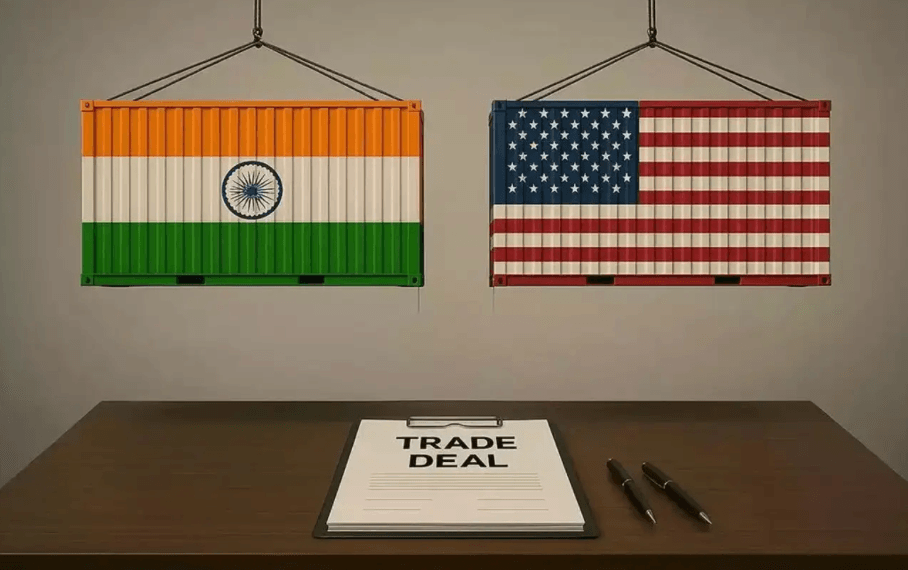
February 3, 2026 – The United States and India announced a bilateral trade agreement on February 3, 2026, following a telephone conversation between US President Donald Trump and Indian Prime Minister Narendra Modi on February 2, 2026. This document provides a comprehensive factual overview of the announced terms, background, timeline, and current status of the agreement.
Announcement Date and Method
Announcement Date: February 2-3, 2026
Announcement Method:
- US President Donald Trump announced the agreement via Truth Social on February 2, 2026
- Prime Minister Narendra Modi confirmed the agreement via posts on X (formerly Twitter) on February 3, 2026
- Announcements followed a telephone conversation between the two leaders on February 2, 2026
Current Status: The agreement has been announced but no formal text has been released publicly as of February 3, 2026. The announcements constitute a preliminary agreement or framework, with details pending formal documentation.
Core Tariff Provisions
US Tariffs on Indian Goods
Previous Rate: 25% reciprocal tariffs (increased from 50% which was briefly imposed)
New Rate: 18% effective immediately according to Trump’s announcement
Scope: The tariff reduction applies to Indian goods exports to the United States
Implementation Timing: Trump stated the changes would be “effective immediately,” though formal Federal Register publication and specific implementation dates have not been confirmed
Indian Tariffs on US Goods
Trump’s Claim: India agreed to “reduce their tariffs and non-tariff barriers against the United States to zero”
Modi’s Statement: Modi’s announcement did not confirm zero tariffs, stating only that “Made in India products will now have a reduced tariff of 18 per cent”
Indian Government Sources: Government sources stated that farmers’ interests are protected and there has been no compromise on dairy sector protections, suggesting that agriculture may not be subject to zero tariffs
Current Uncertainty: The specific tariff reductions India will implement on US goods have not been detailed in official announcements
Indian Purchase Commitments
Total Purchase Target
Amount: Over $500 billion in US goods
Categories Specified by Trump:
- Energy
- Technology
- Agricultural products
- Coal
- Other products (not specified)
Timeframe: Not specified in announcements
Energy Sector Commitments
Russian Oil:
According to Trump’s announcement:
- India agreed to “stop buying Russian Oil”
- India will “buy much more from the United States and, potentially, Venezuela”
- Trump stated this would “help END THE WAR in Ukraine”
According to Indian Government Sources:
- India rejected the characterization that it agreed to completely halt Russian oil purchases
- Government sources stated energy choices are guided by national interest
- Sources confirmed India will buy Venezuelan oil “now that sanctions are lifted”
- India had already been reducing Russian crude purchases prior to the agreement
Context:
- Late 2025: Indian state-run refiners signed first long-term deal with US to import 2.2 million tons of liquefied petroleum gas (LPG) in 2026
- January 2026: Private Indian refiners reportedly reduced Russian oil purchases
- India’s 2024 agricultural trade deficit with US: $1.3 billion
Defense and Technology
Specified Purchases:
- Defense equipment
- Aircraft
- Electronics
- Technology products (categories not detailed)
Amount: Not specified separately from total $500 billion commitment
Agricultural Products
US Agriculture Secretary Brooke Rollins Statement: The deal will expand farm exports into India’s market and “go a long way to reducing” the agricultural trade deficit
Indian Government Position: No compromise on farmers’ interests or dairy sector protections
Uncertainty: Specific agricultural products, quantities, and tariff treatment not detailed in announcements
Bilateral Trade Volume Target
Target: $500 billion in bilateral trade by 2030
Context: This target was previously announced during Prime Minister Modi’s February 13, 2025 Washington visit
Current Trade Volume: Not specified in recent announcements
Comparative Tariff Rates
Following the agreement, India faces an 18% US tariff rate. This compares to:
- Pakistan: 19%
- Vietnam: 20%
- Bangladesh: 20%
- Previous India rate: 25% (and briefly 50%)
The 18% rate makes India’s tariff burden slightly lower than these regional competitors in manufacturing.
Timeline of Negotiations
February 13, 2025
Prime Minister Modi visited Washington. Both sides agreed to work towards a limited trade deal by autumn 2025. Set target to expand bilateral trade to $500 billion by 2030.
March-April 2025
Commerce Minister Piyush Goyal traveled to Washington and met US Commerce Secretary Howard Lutnick and US Trade Representative (USTR) Jamieson Greer. American officials subsequently visited Delhi.
April 2, 2025
US marked “Liberation Day” by imposing 26% tariffs on Indian goods. Subsequently announced 90-day pause on reciprocal tariffs to allow negotiations.
April 16, 2025
During US Vice President JD Vance’s visit to India, both sides finalized terms of reference for trade talks, raising expectations for agreement before July 9, 2025.
May-July 2025
Commerce Minister Goyal returned to Washington with chief negotiator Rajesh Agrawal. Despite Trump stating a “big” deal was coming, talks reportedly stalled over import duties on agricultural products.
August 2025
Trump imposed 50% tariffs on Indian goods, citing India’s purchase of Russian oil.
Modi stated India would “never compromise” on interests of farmers, livestock rearers and fishermen.
Late 2025
Indian state-run refiners signed first long-term deal with US for 2.2 million tons of LPG imports in 2026.
January 27, 2026
USTR Jamieson Greer stated India had made “a lot of progress” in talks, though energy imports and agricultural market access remained under discussion.
January 27, 2026 (same day)
India and European Union finalized comprehensive Free Trade Agreement.
January 2026
Private Indian refiners reportedly reduced Russian oil purchases.
February 2, 2026
Trump and Modi held telephone conversation.
Trump announced trade deal via Truth Social.
February 3, 2026
Modi confirmed agreement via X platform posts.
Commerce Minister Piyush Goyal expected to make statement in Indian Parliament (as of February 3).
What Remains Unclear
As of February 3, 2026, several key aspects of the agreement lack official clarification:
Formal Agreement Text
No written agreement text has been published or made available for review.
Indian Tariff Reductions
- Whether India actually agreed to zero tariffs and zero non-tariff barriers across all categories
- Specific sectors and products affected by Indian tariff reductions
- Timeline for implementation of Indian tariff changes
- Agricultural sector treatment
Energy Commitments
- Whether India completely halts Russian oil purchases or reduces them
- Specific volumes of US energy purchases committed
- Timeline for energy purchase commitments
- Treatment of Venezuelan oil purchases
Agricultural Provisions
- Specific US agricultural products gaining access to Indian market
- Indian agricultural export opportunities to US
- Dairy sector treatment
- Tariff rates on agricultural products in both directions
Services Sector
- Treatment of services trade
- H-1B visa and immigration policy implications
- IT and business process outsourcing provisions
Implementation Timeline
- Formal signing date
- Effective dates for tariff changes
- Phase-in schedules if applicable
- Compliance and verification mechanisms
Legal Authority
- Whether agreement requires US Congressional approval
- Legal framework under which agreement operates
- Binding nature of announced commitments
Purchase Commitments
- $500 billion timeframe
- Specific product breakdowns
- Verification and monitoring mechanisms
Congressional and Legal Questions
Congressional Approval: Legal experts and some Democratic lawmakers have questioned whether Trump can finalize binding trade agreements without Congressional approval.
Administration Position: Trump and supporters argue Congress has ceded authority to the executive branch for such agreements.
Industry Perspective: Lori Mullins, director of operations at Rogers & Brown Custom Brokers, stated that trade agreements are “official once the Federal Register notice is posted with dates, times and applicable tariff codes.”
Current Status: No Federal Register notice has been published as of February 3, 2026.
Market and Economic Response
Indian Stock Market
Following the announcement, Indian equity markets responded positively:
- Sensex surged over 5%
- Nifty approached record highs
- Export-oriented sectors showed gains
Specific Sector Impacts Noted
Solar Energy:
- Seven-percentage-point tariff reduction (from 25% to 18%) enhances cost-competitiveness
- Industry expects increased exports of solar cells and modules to US market
Automotive:
- TVS Motor Company Chairman Sudarshan Venu stated reduction would enhance export competitiveness
Overall Manufacturing:
- Industry leaders characterized the deal as enhancing export competitiveness and confidence in bilateral economic relations
Currency
- Indian Rupee strengthened following the announcement
Political Responses in India
Government and Ruling Coalition
Members of the ruling National Democratic Alliance (NDA) welcomed the agreement.
Industry leaders including:
- Harsh Goenka (RPG Enterprises Chairman): Called it “the father of all deals” following the “mother of all deals” with EU
- Ajay Singh (SpiceJet Chairman and Managing Director): Welcomed the pact
- Sudarshan Venu (TVS Motor Company Chairman): Highlighted export competitiveness benefits
Opposition Response
Congress MP K.C. Venugopal:
- Moved adjournment motion in Lok Sabha seeking discussion on the agreement
- Alleged potential “adverse consequences” for Indian industries and farmers
- Questioned opening of Indian markets to US goods
- Raised concerns about agricultural sector impact
- Highlighted implications for strategic autonomy regarding Russian oil
Congress General Secretary Jairam Ramesh:
- Criticized the agreement as “complete surrender”
- Noted pattern of major policy developments being announced first from US side
- Questioned whether full details were shared with Indian public
Related Agreements
India-EU Free Trade Agreement
Finalized January 27, 2026 (one week before India-US announcement)
The EU agreement:
- Covers 2 billion people and $27 trillion market
- Eliminates 96.6% of tariffs between India and EU
- Described by European Commission President Ursula von der Leyen as “the mother of all deals”
Context: Some analysts predicted EU-India agreement would “light a fire” under US-India negotiations.
India-Australia Trade Deal
Previously concluded
India-UK Trade Deal
Previously concluded
Comparison: Indian Commerce Minister Piyush Goyal stated India’s services commitments in the US deal are the most ambitious India has ever made, surpassing commitments in UK and Australia agreements.
Strategic and Geopolitical Context
US Perspective (as stated by officials and analysts)
Mark Linscott (Senior Fellow on India, Atlantic Council, former US trade official):
- Characterized the deal as “a confidence-building measure”
- Noted it helps both sides “work through their various issues”
Strategic Objectives:
- Unprecedented US market access in India
- Increased agricultural exports to India
- Reduced US agricultural trade deficit with India
- Strategic alignment regarding Russian oil purchases
Indian Perspective (as stated by officials and analysts)
Arpit Chaturvedi (South Asia advisor, Teneo):
- Agreement “carries greater strategic weight” than EU deal
- “Reinforces India’s place within the Western supply chain and strategic calculus”
- Characterized as “reset in India-U.S. strategic relations”
Strategic Objectives:
- Reduced tariff burden compared to regional competitors
- Access to US market for Made in India products
- Strengthened position in global supply chains
- Restored stability in bilateral ties
Regional Competition Context
The 18% US tariff rate positions India favorably compared to:
- Pakistan (19%)
- Vietnam (20%)
- Bangladesh (20%)
These countries are competitors in manufacturing exports to the United States.
Implementation and Next Steps
Expected Near-Term Actions
Joint Statement: Analysts expect a joint statement to be released
Legally Binding Text: Formal agreement text anticipated in coming weeks
Parliamentary Statement: Indian Commerce Minister Piyush Goyal expected to make statement to Parliament
Tariff Implementation: Actual tariff changes unlikely until formal Federal Register publication (US) and official notification (India)
Remaining Negotiations
USTR Jamieson Greer previously stated (January 27, 2026) that some elements remain under discussion:
- Energy imports
- Agricultural market access
Basant Sanghera (Managing Principal, The Asia Group):
- Noted tariff reductions represent “only the first phase of the bilateral agreement”
- Stated both sides need to finalize legally binding text
Background: Recent Tensions in Bilateral Relations
May 2025
Trump claimed to have mediated an end to India-Pakistan conflict, which New Delhi rejected.
August 2025
Washington imposed additional tariffs (eventually reaching 50%) over India’s Russian oil purchases while sparing China, the largest importer of Russian energy.
Context of Tensions
- India’s continued purchase of Russian oil after Ukraine war began had been a persistent friction point
- Trump criticized India for not buying enough American products
- Trade negotiations had stalled over agricultural import duties
Recent Improvement Signs
- January 2026: India reduced Russian oil purchases
- Late 2025: India signed LPG import deal with US
- Appointment of new US ambassador Sergio Gor, who stated negotiations were advancing
Statistical Context
India-US Trade Relationship
US Position: One of India’s top export markets
Agricultural Trade:
- 2024 US-India agricultural trade deficit: $1.3 billion
- US seeks to reduce this deficit through increased agricultural exports to India
Total Bilateral Trade: Current figures not provided in recent announcements; target is $500 billion by 2030
India’s Global Trade Agreements
India has concluded multiple free trade agreements:
- ASEAN
- Japan
- South Korea
- United Kingdom
- Australia
- European Union (January 27, 2026)
- United States (February 3, 2026 – announced)
Key Unknowns Requiring Clarification
The following aspects require official clarification or formal documentation:
- Complete text of agreement
- Indian tariff reduction schedule and scope
- Exact nature of Russian oil commitment
- Specific agricultural products and tariff rates
- Services sector provisions
- Timeline and phases of implementation
- Verification and compliance mechanisms
- Legal framework and Congressional role
- Specific product categories under $500 billion purchase commitment
- Indian agricultural export opportunities to US
Conclusion
The India-US trade deal announced February 2-3, 2026, represents a significant development in bilateral economic relations. The core announced provisions include reduction of US tariffs on Indian goods from 25% to 18%, Indian purchase commitments totaling over $500 billion in US energy, technology, agricultural and other products, and commitments regarding energy purchases including Russian oil.
However, many specific details remain unclear pending release of formal agreement text, including exact Indian tariff commitments, agricultural provisions, services sector treatment, and implementation timelines. The agreement has been characterized by both governments as strengthening bilateral ties and comes after months of tension over tariffs and India’s Russian oil purchases.
Full assessment of the agreement’s scope and impact will require publication of the complete legal text and formal implementation documents.
This document provides factual information based on official announcements and media reports as of February 3, 2026. It does not include analysis or opinions regarding the merits or implications of the agreement.
Leave a Reply