
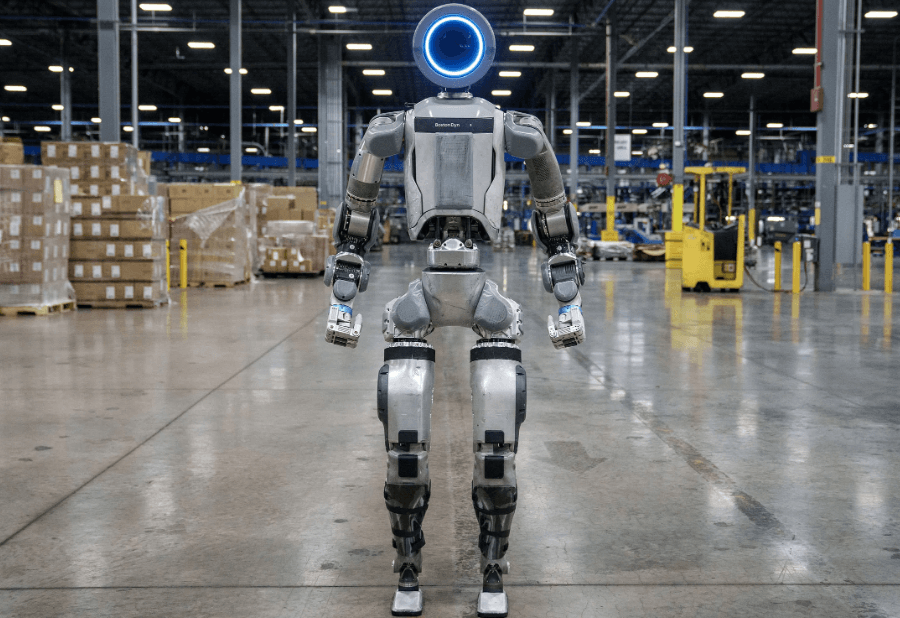
If you’ve spent any time on the internet over the last decade, you’ve seen them: the viral videos of Boston Dynamics’ robots doing backflips, dancing to Motown, or being bullied with hockey sticks to test their balance. For years, these robots were the world’s most famous science projects stunning, but mostly confined to laboratory hallways and YouTube.
That era officially ended this week at CES 2026.
Hyundai Motor Group, which now owns Boston Dynamics, just dropped a bombshell: they aren’t just “testing” humanoid robots anymore. They are mass-producing them. Hyundai announced plans to build an annual production system for 30,000 Atlas robots by 2028.
This isn’t just about making cool videos. This is about the total transformation of the global workforce.
The Birth of the “Product” Atlas
For the first time, we saw the production-ready version of the electric Atlas. Gone are the bulky hydraulic tubes and the hiss of pressurized fluid from the old prototype. The new Atlas is sleek, silent, and surprisingly “friendly” looking.
But don’t let the blue-hued, minimalist design fool you. This thing is a powerhouse designed for the grit of a car factory, not just a clean room.
The Specs that actually matter for business:
- 360-Degree Movement: Every joint can rotate fully. If Atlas needs to pick up a part behind it, it doesn’t turn its body—it just spins its torso and neck 180 degrees. It moves in ways humans can’t, making it more efficient than a biological worker in cramped spaces.
- Strength: It can lift up to 50kg (110 lbs).
- Tactile Hands: Unlike previous “claws,” these hands have human-scale fingers with pressure sensors, allowing it to handle delicate components without crushing them.
- Infinite Shift: When its battery runs low, it doesn’t go to sleep. It autonomously walks to a dock, swaps its own battery for a fresh one, and gets back to the line in seconds.
The Strategy: “Eat Your Own Dog Food”
Hyundai isn’t trying to sell these to you for your home (yet). Their strategy is brilliant and pragmatic: they are going to be their own best customer.
Starting in 2028, the first “fleets” of these 30,000 bots will be deployed at the Hyundai Motor Group Metaplant America in Savannah, Georgia.
They are starting with “boring” tasks: parts sequencing and logistics. These are the repetitive, back-breaking jobs that lead to human injuries and high turnover. By 2030, Hyundai expects Atlas to move into full-scale component assembly actually putting the cars together alongside human coworkers.
By using their own factories as a massive testbed, Hyundai is doing something no other robotics company (including Tesla with Optimus) has done at this scale: generating millions of hours of real-world production data to “teach” the AI.
The Secret Sauce: DeepMind and NVIDIA
Building a robot that can move is a hardware problem. Building a robot that can think is a software problem.
To solve this, Hyundai isn’t working alone. They announced two massive partnerships this week:
- Google DeepMind: They are integrating DeepMind’s foundation models directly into Atlas. This gives the robot “cognitive capabilities” the ability to understand spoken instructions and navigate “unstructured” environments where things aren’t always in the same place.
- NVIDIA: They are using NVIDIA’s “Physical AI” clusters to run massive simulations. Atlas “practices” a task 10,000 times in a virtual world before it ever touches a real car part in the physical world.
Why 30,000?
The number “30,000” is highly specific. It’s the threshold for economies of scale.
At this volume, the cost of producing a humanoid robot drops significantly. Hyundai Mobis is already standardizing the “actuators” (the motors that act as muscles), treating them like any other car part. When you mass-produce actuators by the hundreds of thousands, the $100,000 robot suddenly becomes a $30,000 robot.
At that price point, the ROI for a factory owner becomes undeniable.
The “Robotics-as-a-Service” (RaaS) Model
Perhaps the most interesting part of the announcement was the business model. Hyundai doesn’t just want to sell you a robot; they want to rent you a worker.
Through their Robotics-as-a-Service (RaaS) model, businesses can subscribe to an Atlas fleet. Hyundai handles the hardware maintenance, the software updates, and the repairs. For a warehouse manager, it’s not a capital expense; it’s an operational one—like hiring a temp agency, but the workers never get tired, never complain, and never quit.
The Human Verdict
There is a lot of fear surrounding 30,000 robots entering the workforce every year. And let’s be real: some jobs willchange.
But Hyundai’s pitch is focused on “Partnering Human Progress.” They are targeting the “3D” jobs: Dirty, Dull, and Dangerous. The goal is to let the robots do the heavy lifting (literally) so humans can move into roles that require judgment, creativity, and empathy things the Atlas, for all its 56 degrees of freedom, still can’t do.
We are watching the birth of a new industry. In 1926, the world was figuring out the assembly line. In 2026, we are figuring out the autonomous worker. Hyundai just placed a $26 billion bet that the future has two legs and a battery pack.
Would you work alongside an Atlas bot, or does the 360-degree head spin freak you out a little too much?