
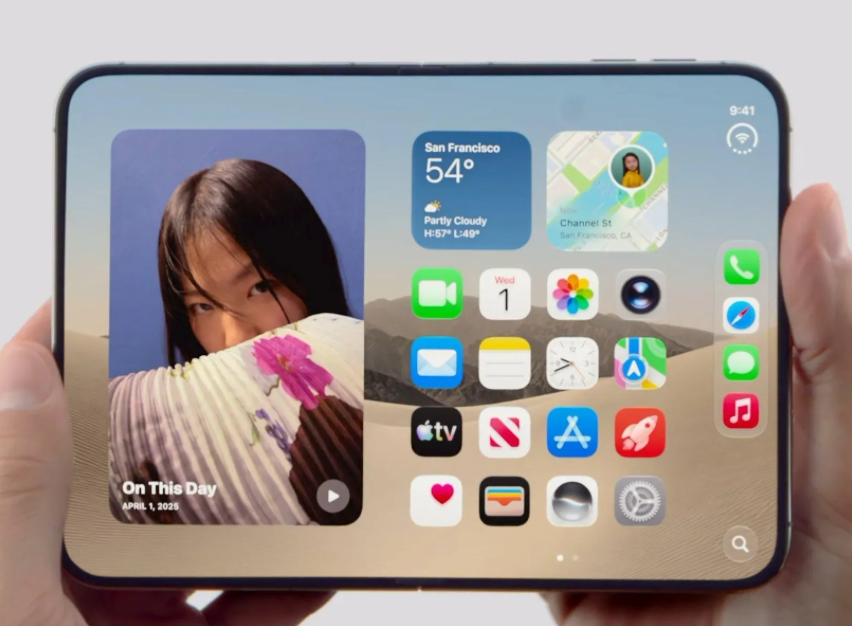
Apple introduced the iPhone Duo on 9 September 2026. It starts at $1,999, pre-orders open Friday 16 October, and it ships Friday 23 October.
Samsung shipped the original Galaxy Fold in 2019. Apple is arriving seven years late to a category its competitors defined, at a price that matches Samsung rather than beating it, with a device that will not reach stores for another six weeks.
On paper that is a company playing catch-up badly.
Read the actual engineering and a different picture emerges. Apple did not spend seven years failing to build a foldable. It spent seven years refusing to ship one until the two problems that define the category were solved. Whether it solved them is the only question worth asking about this device.
The two problems every foldable has
Every foldable phone since 2019 has fought the same pair of issues.
The first is the crease. Fold a display repeatedly and a visible line forms where the panel bends. Manufacturers have reduced it substantially over the years, but on most devices you can still see it in the right light and feel it under your thumb.
The second is durability. A hinge is a mechanical part in a device that gets opened and closed thousands of times, and the display above it is glass being asked to bend. Early foldables failed at both, sometimes spectacularly.
Apple’s engineering answers to both are unusually specific.
What Apple actually built
The hinge contains more than 100 components. It uses a variable torque profile to control the feel of opening and closing, supports the centre of the display to hold it flat when open, and closes against an integrated magnet array.
More interesting is the structural work around it. Support ribs reinforce the frame for stiffness. Antenna splits use ceramic fibre inserts to add rigidity. The frame is grade 5 titanium, with a titanium plate as the base layer and carbon fibre support plates in the hinge assembly.
Apple stated during the presentation that the reinforced hinge structure is three times stronger than grade 5 titanium alone.
The display stack is where the crease problem gets addressed. The inner display uses a nano-textured cover layer made from a custom polymer that Apple says is up to 40 percent stiffer than materials others in the industry use, with a scratch-resistant coating on top and high-strength glass above and below the folding layer.
The nano-texture is doing double duty. It reduces glare, which Apple pitched as a viewing benefit, but a matte surface also scatters light rather than reflecting it cleanly, which is precisely what makes a crease visible. Reducing reflections reduces crease visibility. That is a clever piece of problem-solving, and it is worth noting it is a mitigation rather than an elimination.
There is one manufacturing detail that deserves more attention than it got. Apple said it uses AI algorithms during production to pair each individual hinge with its best-fit housing, ensuring precise alignment.
That is component-level matching at scale, on a part with more than 100 pieces, across millions of units. It is the sort of process investment that explains both why this took seven years and why it costs $1,999.
The specifications that matter
Displays. A 5.4-inch outer Super Retina XDR display, and a 7.6-inch inner display that Apple says is 50 percent larger than the iPhone 18 Pro Max screen. Both support ProMotion, Always On, and 3,000 nits peak outdoor brightness.
The detail that actually affects daily use is that both displays share the same aspect ratio. Content scales proportionally between them, so apps do not reflow awkwardly when you open or close the device. Anyone who has used a foldable knows that app continuity is where the experience usually breaks down.
Apple also claims the closed 5.4-inch outer display delivers 90 percent of the screen area of an iPhone 18 Pro, which addresses the other common foldable complaint: that the cover screen is too cramped to use without opening the device.
Silicon. A20 Pro, the same chip as the iPhone 18 Pro, with a display engine supporting dual displays, a custom vapour chamber, and Apple’s C2 modem.
Battery. A dual-battery architecture. Apple claims up to 31 hours using the inner display, up to 44 hours on the outer display alone, and around 24 hours of typical mixed use.
Authentication. Touch ID in the side button rather than Face ID. You can also unlock with an Apple Watch. The FaceTime camera sits under the display.
Build. Grade 5 titanium with a mirror-polished finish and a 3D-printed hinge cover. Ceramic Shield on the back, Ceramic Shield 2 on the front with three times better scratch resistance than the previous generation. IP68.
Storage and colours. 256GB, 512GB, 1TB and 2TB, in star white and night sky.
Apple Pencil. Supported with USB-C Apple Pencil, but not at launch. It arrives later this year.
The compromises Apple is not highlighting
Three things are worth being direct about.
The camera is not the Pro camera. The Duo uses a dual 48MP system comparable to the iPhone 17 generation rather than the iPhone 18 Pro’s variable aperture setup. You are paying $800 more than an iPhone 18 Pro and getting a demonstrably weaker camera.
For a device positioned at the top of the lineup, that is a real gap. Physics explains it, since a folding chassis has no room for the thickness a variable aperture mechanism requires, but the explanation does not change the outcome for a buyer.
No Face ID. Touch ID in the side button is a sensible solution for a device with two very different use positions, and it is arguably more practical than Face ID when the phone is lying flat on a desk. It is still a step back from the biometric standard Apple has spent eight years training its customers to expect.
Apple Pencil is not ready. Stylus support is one of the genuinely compelling reasons to buy a large folding screen, and it is shipping later. Buyers at launch are paying for a feature they cannot use yet.
The pricing tells you the strategy
The Duo starts at $1,999. The Samsung Galaxy Z Fold 7 starts at $1,999.
Apple matched rather than undercut, and that is a deliberate signal. A company trying to take a category quickly prices below the incumbent. A company protecting margins on a difficult product prices level and lets the brand do the work.
Reporting ahead of launch indicated Apple exceeded its internal cost targets because of the ongoing memory shortage and absorbed some of that expense to hold the $2,000 line. If accurate, that reinforces the reading: the price was a target Apple defended rather than a number the economics naturally produced.
The October ship date points the same direction. A six-week gap between announcement and availability is unusual for a flagship Apple product and generally indicates production constraints on hardware the company has never manufactured before.
At $1,999 to roughly $3,000 depending on storage, this is a prosumer device. It will not move iPhone unit volumes the way a mainline launch does, and it is not intended to.
Who this is actually for
Buy it if you genuinely work on your phone. The case for a foldable has always been productivity rather than novelty, and a 7.6-inch canvas with proper multitasking, matched aspect ratios and eventual Apple Pencil support is the strongest version of that case anyone has shipped.
Buy it if you currently carry both a phone and an iPad mini. This replaces two devices, and at that framing $1,999 looks considerably more reasonable.
Skip it if photography matters most to you. The iPhone 18 Pro has the better camera for $800 less.
Skip it if you were hoping the first-generation problems are solved. Apple’s engineering answers are more thorough than the competition’s, but this is still generation one of a mechanically complex device. Real-world durability data does not exist yet, and it will not for months.
Wait for reviews if you are on the fence. Six weeks until shipping means independent hinge testing, crease assessment and drop tests will all be published before you need to decide. There is no reason to pre-order blind on a device like this.
What Apple actually did here
The interesting thing about the iPhone Duo is not that Apple made a foldable. Everyone expected that eventually.
It is that Apple let Samsung, Google, Honor and Huawei spend seven years discovering every failure mode in the category, then shipped a device engineered specifically against those failure modes. Component-matched hinges. Ceramic fibre reinforcement. A stiffer cover polymer. Matte texture that suppresses crease visibility. Matched aspect ratios that keep app continuity intact.
That is not innovation in the sense of doing something first. It is the other Apple pattern, the one that produced the iPod and the iPhone: arriving late, watching what breaks, and shipping the version where it does not.
Whether it worked is a question no press release can answer. Hinges fail over months, not in keynote demos, and creases develop with use. The first honest verdict on the iPhone Duo will come around March 2027, from people who have opened it ten thousand times.
Until then, this is the most carefully engineered foldable anyone has announced, at a price that assumes you already believed in the category.
Next steps worth taking
Do not pre-order on 16 October without reading durability testing. There is a full week between pre-order opening and shipping, and independent reviews land in that window.
Compare against the Galaxy Z Fold 7 on camera, not screen. Both are $1,999, and the display specifications are close enough that the camera difference is the real deciding factor.
Budget for the Apple Pencil separately and be aware it will not work at launch.
If you use an iPad mini daily, price the pair. An iPhone 18 Pro plus an iPad mini costs meaningfully more than $1,999, which changes the value calculation considerably.
Leave a Reply