
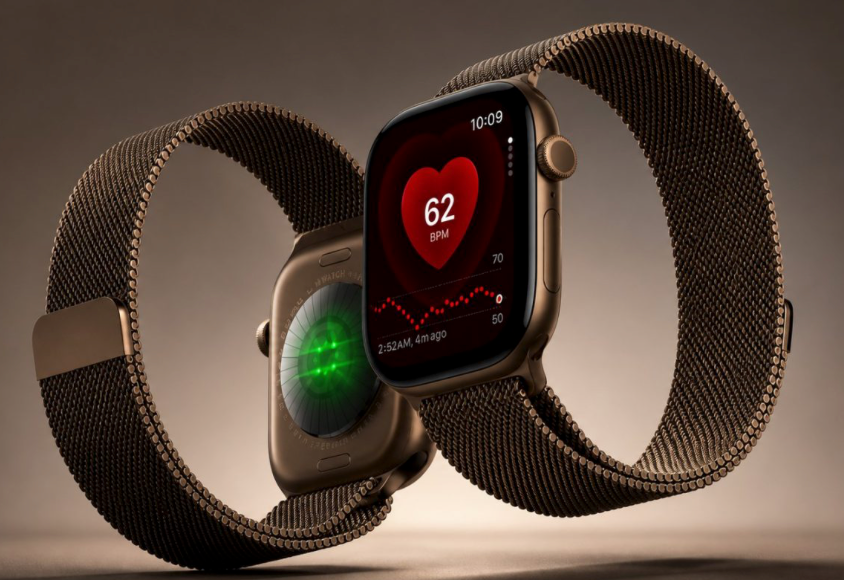
Apple announced the Watch Series 12 and Watch Ultra 4 on 9 September 2026. Series 12 starts at $399, Ultra 4 at $799, both shipping Friday 18 September.
The specification most coverage led with is that heart rate is now measured every five seconds instead of roughly every five minutes. That is a 60x increase in sampling frequency, and it sounds like the kind of number a company puts in a press release because the actual changes were thin.
It is not. That number is the whole product, and everything else announced yesterday depends on it.
Here is why, and what Apple is quietly building underneath it.
What actually changed in the hardware
The rear sensor array has been rebuilt rather than tuned.
The electrode surface is larger, which improves skin contact during ECG readings. The photodiodes are now arranged in a ring pattern to collect light more efficiently. The green LEDs are larger and more power efficient, which is what makes continuous measurement possible without destroying battery life.
That last point is the engineering constraint that mattered. Sampling heart rate 60 times more often is trivial if you do not care about power draw. Doing it while keeping Series 12 at the same 24-hour battery life as Series 11 is the harder problem, and it was solved with LED efficiency rather than a bigger battery.
Driving all of it is the S11, which Apple calls its most powerful wearable chip.
The S11 is more significant than it looks. Series 11 reused the S10, which was itself the same silicon as the S9 from 2023. This is the first genuinely new Apple Watch chip in three generations, and it is what enables the sensing system rather than merely accompanying it.
That has a practical consequence buyers should know: readiness is tied to the S11. Ultra 3 owners will not get it through a watchOS 27 update. This is a hardware feature wearing software clothing.
The accuracy claim, examined
Apple says the new system delivers the most accurate heart rate sensing in a wearable, based on a study of more than 1,000 participants with representation across demographic groups, comparing it against leading commercially available wearables.
The claim is more credible than most marketing accuracy claims for two specific reasons.
The sample size is meaningful, and demographic representation is explicitly mentioned. Optical heart rate sensing has a well-documented accuracy problem across skin tones, because green light absorption varies with melanin. A company that highlights demographic representation in a heart rate study is signalling awareness of exactly that issue.
The caveat is equally important. Apple’s own footnote states the study was conducted by Apple during July and August 2026 against bestselling wearables available as of June 2026.
That is a manufacturer-run study benchmarked against a competitive field the manufacturer selected. It is not fraudulent and the methodology sounds reasonable, but it is not independent validation either. Treat it as a strong claim awaiting third-party confirmation rather than settled fact.
HRV is the metric that actually matters here
Heart rate variability moved from occasional sampling to as often as every five minutes, a 24x increase.
HRV measures the variation in time between heartbeats, and it is one of the better available proxies for autonomic nervous system state. Low variability generally correlates with stress or incomplete recovery. Higher variability generally correlates with better recovery.
Apple has split it into two variants, which is a genuinely useful distinction that most wearables do not make. Recovery HRV captures daily stress and recovery signals. Overall HRV informs broader health status including cardiovascular health.
The reason this matters more than the heart rate headline is that HRV is noisy. A single daily reading, which is what most wearables produce, is heavily influenced by when it was taken and what you happened to be doing. Sampling every five minutes turns a single unreliable data point into a trend line you can actually reason about.
Overnight vitals now includes recovery HRV measured against your personal baseline. A new daytime vitals view sits alongside it, which Apple suggests may catch shifts before they appear in overnight data.
Apple’s own footnote is worth repeating exactly: the Vitals app is for wellness purposes, not medical use.
Readiness, and the ring companies Apple just aimed at
Readiness produces a single score from 0 to 10 each morning, drawn from recent activity, vitals and sleep score, with one of four recommendations: Recover, Pace Yourself, Ready, or Go For It.
It updates through the day as new data arrives, and it shows which factors are driving the number rather than presenting a black box. Apple says the scoring algorithm was developed using data from the Apple Heart and Movement Study alongside exercise scientists and physicians.
Let us be direct about what this is. Oura and Whoop built their entire businesses on readiness scoring. Fitbit has offered a version for years. Apple has now shipped the same category of feature on a device most of its customers already own, at no additional subscription cost.
For Oura in particular, whose ring costs roughly $300 plus a monthly subscription and whose primary differentiator is exactly this, that is a difficult competitive development.
The counterargument is real though. Rings are worn overnight more consistently than watches, and sleep data quality depends heavily on compliance. If you take your watch off to charge at bedtime, readiness works with a gap in its most important input.
The part almost nobody covered
The watch got the headlines. The Health app redesign is the bigger story.
Apple announced a rebuilt Health app arriving later this year with two new tabs. Insights surfaces a daily summary across heart, sleep, readiness, fitness, vitals and cycle data. Longevity analyses longitudinal data across heart health, sleep, mental wellbeing, movement, metabolic health, hearing and nutrition.
Inside Longevity sits Health Age, which estimates how your metrics track against your chronological age using VO2 max, resting heart rate, sleep and HRV, and which can incorporate lab data including A1c and LDL.
Then there are two features that quietly change what an Apple device is.
Movement evaluations let you run physical assessments at home using the iPhone camera and Apple Watch, measuring flexibility, strength, balance, movement mechanics and VO2 max. Apple states this runs entirely on device with no video recorded, stored or shared, using vision-based AI models developed with clinician input.
These are assessments that normally require an appointment with a physical therapist or exercise physiologist.
Labs goes further. Users will be able to schedule and purchase blood panels covering more than 50 biomarkers for $119, directly through the Health app, at roughly 2,000 Quest Diagnostics locations in the US.
Read that again. Apple is now selling diagnostic blood testing through a first-party app.
That is a different business from selling watches. It puts Apple in the consumer diagnostics market alongside companies like Function Health, and it establishes a direct commercial relationship between Apple and your bloodwork.
Whether that is good depends entirely on execution and on how the resulting data is governed. Apple’s privacy record here is stronger than most, and the on-device processing commitment for movement evaluations is meaningful. But a company that sells you a test, interprets the result, and then recommends what to do about it occupies a position worth watching carefully.
Ultra 4, briefly
Ultra 4 uses the same sensing platform and S11 chip in the rugged body.
Battery is the differentiator. Apple claims more than two days of everyday use at up to 50 hours, 84 hours in Low Power Mode, 18 hours of full workout tracking with GPS and heart rate, and up to 45 hours in Max Extended Workout mode. A 15-minute charge adds up to 18 hours.
It comes in natural and black titanium with refreshed bands, including a new titanium Hermès option.
For anyone doing ultra-distance events or multi-day expeditions, the battery numbers are the reason to choose it. For everyone else, Ultra 4 is a $400 premium for endurance you will not use.
Cycle Tracking, which deserves more attention than it got
With iOS 27, Cycle Tracking adds perimenopause and menopause support.
Users can log that they are in perimenopause or menopause, track symptoms and monitor cycles over time. If bleeding is logged after menopause, the app prompts a conversation with a doctor. Users aged 40 and over can receive a notification when logged cycle deviations suggest perimenopause.
That last feature addresses something genuinely underserved. Perimenopause symptoms can begin years before the final period, and many people do not recognise what they are experiencing. A prompt to raise it at the next appointment is a low-risk, potentially high-value intervention.
Apple’s footnote applies: Cycle Tracking should not be used as a form of birth control.
Who should buy what
Series 12 at $399 if you are on Series 9 or earlier, or if readiness and continuous HRV are things you would actually use. The sensing upgrade is the most substantive Apple Watch hardware change in several years.
Skip it if you have a Series 11 and do not care about readiness. Same 24-hour battery, same broad design. The sensing improvements are real but incremental for casual use.
Ultra 4 at $799 only if battery life is a genuine constraint for you. Multi-day hiking, ultra events, expedition use. Otherwise you are paying a large premium for headroom.
Consider your ring if you own an Oura or Whoop. Apple now covers the same ground without a subscription, though ring wear compliance overnight remains a real advantage.
Note the software timing. watchOS 27 arrives 14 September for Series 9 and later, SE 3, and Ultra 2 and later. The redesigned Health app comes later this year, US English first, and requires an Apple Intelligence-enabled iPhone. Health Age requires an Apple Watch.
The bottom line
The Series 12 is not a watch upgrade. It is a sensor upgrade that happens to be attached to a watch.
Continuous five-second heart rate sampling and five-minute HRV are the foundation, the S11 chip is what makes them affordable in power terms, and readiness is the first visible application. More applications will follow, because that is what the data volume is for.
The accuracy claim is credible but manufacturer-run, and worth confirming against independent testing before treating it as established.
The genuinely significant announcement was not the watch at all. It was Apple selling $119 blood panels through the Health app and running clinical-style movement assessments with a phone camera. Apple has spent a decade positioning the Watch as a health device. Yesterday it started positioning the iPhone as a health provider.
That is a much larger move, and it got a fraction of the coverage.
Next steps worth taking
Check watchOS 27 compatibility before upgrading. Series 9 or later, SE 3, or Ultra 2 or later, paired with iPhone 11 or later on iOS 27.
Do not expect readiness on an Ultra 3. It requires the S11, so no software update will bring it to older hardware.
Wait for independent heart rate testing before treating the accuracy claim as settled. The DC Rainmaker and Quantified Scientist style comparisons usually land within a few weeks of release.
If you are outside the US, temper expectations on Health app features. Labs is US-only through Quest, and the redesigned app starts in US English with other languages following.
One caveat worth holding onto: readiness scores, Health Age and vitals are wellness tools, not diagnostics. Apple says so in its own footnotes. A number that tells you to recover is useful context, not a medical opinion, and anything that actually concerns you belongs in front of a doctor.
Leave a Reply