
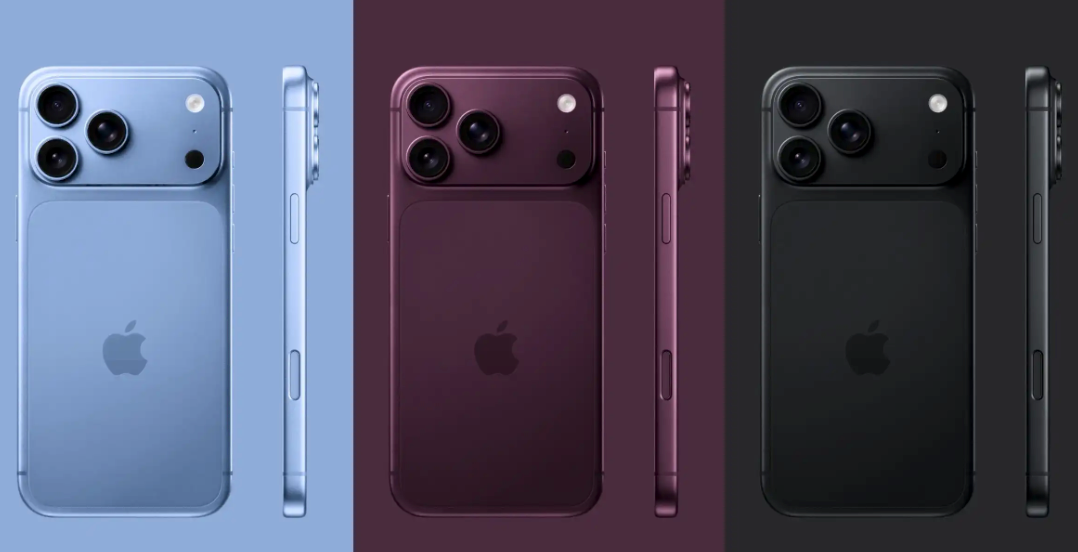
Apple announced the iPhone 18 Pro and iPhone 18 Pro Max on 9 September 2026. Pre-orders open Saturday 12 September, with devices arriving Friday 18 September.
If you read the coverage that went up within the hour, you got a list. Faster chip, better battery, new colour, bigger numbers. Every year produces that list, and every year it tells you almost nothing about whether the phone is worth buying.
So here is a different framing. Of everything Apple announced, exactly two things are genuinely new rather than incrementally better. Everything else is the annual tightening of screws.
Those two things are variable aperture and Apple Reference Image. One of them is getting all the attention. The other is more important.
The physical camera change
The iPhone has always had a fixed aperture. Whatever light the lens let in, it let in, and every creative decision about depth of field was made in software afterwards.
That changed. The new 48MP Fusion Main camera uses six laser-cut blades driven by a rotor mechanism to move between apertures physically, the way a real camera lens does.
The range spans roughly ƒ/1.48 at the wide end for low light, through ƒ/1.8 which Apple has tuned for portraits, up to ƒ/4 for keeping more of a group in focus. The camera picks automatically, or you can set it yourself through the new Pro controls interface, which also exposes shutter speed, white balance and a live histogram.
There is a developer API for the full aperture range, which matters more than it sounds. Third-party camera apps like Halide and Kino will be able to build on this directly rather than waiting for Apple to expose it piecemeal.
Here is the honest assessment. This is a real hardware capability that iPhones have never had, and for anyone who shoots seriously it removes a genuine limitation. It is also, for most people, going to be invisible. The camera will adjust automatically and photos will be slightly better in ways nobody consciously notices.
Worth having. Not worth upgrading for on its own.
The feature nobody is leading with
Apple Reference Image is the more consequential announcement, and it is buried well below the fold in most coverage.
The new Main camera sensor can cryptographically sign every pixel it captures. Shoot in the new Reference mode and the camera records signed sensor data, which Private Cloud Compute develops into an unalterable reference image. That reference sits in the Photos app alongside your edited version, functioning like a digital negative you can compare against.
APIs across iOS, iPadOS and macOS 27 let third-party apps display these reference images too. Apple is also adding support for the SynthID standard in a later software update, which helps flag images that were generated or edited with AI.
Think about what this actually addresses.
We are roughly two years into a period where any photograph can be fabricated convincingly and cheaply. The practical consequence is not that people believe fake images. It is that people have stopped being able to trust real ones. A photojournalist with genuine evidence and a bad actor with a generated image currently arrive at the same level of public scepticism.
A cryptographic signature at the sensor level is one of the few technically serious responses to that problem. It does not prove a photograph is meaningful or honestly framed. It proves a specific sensor saw specific light at a specific moment, and that what you are looking at either matches that record or does not.
Two caveats worth stating plainly, because Apple states them only in footnotes.
Reference Image is opt-in, not default. And it is not available at launch in China due to regulatory requirements, while in the EU users can view and develop reference images but cannot capture them initially.
An authenticity feature that most users never switch on, unavailable in two of the world’s largest markets, is a considerably smaller thing than the announcement suggests. But the direction is right, and the fact that it ships in hardware rather than software is what makes it credible.
The chip, honestly assessed
A20 Pro is built on a 2-nanometre process. The specifics Apple published:
- 6-core CPU with integrated Neural Accelerators
- 7-core GPU, up to 40 percent faster than A19 Pro
- Dual 16-core Neural Engine, 32 cores total, double the AI processing of A19 Pro
- 50 percent more memory bandwidth than A19 Pro
The thermal story is more interesting than the raw numbers. Apple borrowed packaging from its M-series Mac chips, placing the silicon die beside the memory rather than stacked with it. That pulls the memory out of the chip’s thermal path and lets A20 Pro sit directly against a redesigned vapour chamber with three times the surface area of the iPhone 17 Pro version.
The result Apple claims is up to 40 percent better sustained performance.
Sustained is the word doing the work. Peak benchmark scores have been comfortably ahead of real-world need on iPhones for several years. What actually degrades your experience is thermal throttling during long video recording, extended gaming sessions, or heavy on-device AI processing.
If Apple’s numbers hold up under independent testing, this is the more meaningful performance change, and it is the one that benchmark headlines will underreport.
Battery, which is genuinely the headline for most people
The eSIM-only models deliver up to 36 hours of video playback on the iPhone 18 Pro and up to 45 hours on the Pro Max.
The mechanism is worth understanding. Dropping the physical SIM tray frees interior volume, which Apple filled with battery. Apple states this accounts for two additional hours of video playback on eSIM-only units.
That creates an unusual situation. The eSIM-only models are not just a connectivity choice, they are meaningfully better hardware. Those models ship in the US, Canada, Japan, Mexico, the UAE, Saudi Arabia and several other markets. Buyers elsewhere, India included, get the physical SIM version and slightly less battery.
Charging improved as well. The Pro reaches 50 percent in around 15 minutes wired, or 30 minutes wireless. On the Pro Max, Apple says five minutes of wired charging yields roughly seven hours of video playback, though these figures depend on a 60W-capable cable and an adapter most people do not own.
Everything else, briefly
Dynamic Island got smaller and now displays up to three Live Activities simultaneously. Face ID still works through it.
C2 modem, Apple’s second-generation in-house cellular silicon, delivers faster uploads than C1X while using 15 percent less energy, and adds mmWave support in the US.
N1 wireless chip handles Wi-Fi 7, Bluetooth 6 and Thread.
Colours are black, silver, glacier and a new burgundy. The aluminium frame and Ceramic Shield rear are more closely colour-matched than before.
iOS 27 ships Monday 14 September, bringing Apple Intelligence and Siri AI in beta.
Siri AI deserves a note of caution. It is arriving as a beta, in English first, with French, Japanese, Korean, Portuguese and Spanish following in October. It will not be available in the EU at launch. Certain server-side Apple Intelligence features carry daily usage limits, and Apple has stated that expanded access will carry a fee in future.
Buying a phone for an assistant that ships in beta with usage caps is a decision worth making with open eyes.
Pricing, and the missing model
The iPhone 18 Pro starts at $1,199 in the US, the Pro Max at $1,299. Storage runs 256GB, 512GB, 1TB and 2TB.
Pre-orders open 12 September across more than 65 countries including India, the UK, the UAE, Australia, Japan and Brazil, with 20 further markets following on 25 September.
Now the part that affects more buyers than any spec on this page.
There is no standard iPhone 18 this autumn. Reporting ahead of the event indicated Apple has split its launch cycle, with the iPhone 18, iPhone 18e and iPhone Air 2 expected in spring 2027.
If you were waiting for the non-Pro model to arrive at a lower price, you are waiting until next year. Your realistic options right now are paying Pro money, buying a discounted iPhone 17, or holding.
That is a meaningful change to how Apple’s lineup works, and it received a fraction of the attention that the camera did.
Who should actually buy this
Upgrade if you shoot photography or video seriously. Variable aperture plus Pro controls plus the sustained performance improvement is a coherent package for that use case, and it is the first iPhone in several years where the camera change is hardware rather than processing.
Upgrade if you are on an iPhone 14 or older. The cumulative gap in battery, chip and camera is large enough to feel immediately.
Wait if you have an iPhone 17 Pro. Same design, same display sizes, better internals. Apple is expected to redesign the iPhone substantially next year for its 20th anniversary, and skipping one cycle costs you very little.
Wait if you were budgeting for a standard iPhone 18. It is not here. Spring 2027 is the reported timeline, and buying up to a Pro to avoid waiting is a $1,199 solution to a patience problem.
Consider the eSIM-only model if you are buying in a market that offers it. Two extra hours of video playback for free is not nothing.
The bottom line
The iPhone 18 Pro is a strong iterative release with one genuine hardware first and one quietly important idea.
Variable aperture is the marketable feature and it works, but its practical effect for most users will be photos that are slightly better in ways they cannot articulate.
Apple Reference Image is the one worth watching. A phone camera that cryptographically signs what its sensor saw is a serious attempt at a problem the entire information ecosystem is currently failing at. That it ships opt-in and geographically restricted limits its immediate impact considerably. That it ships at all, in hardware, from the company that sells more cameras than anyone, sets a standard others will have to answer.
The rest is a good year of engineering. Faster chip, better thermals, longer battery, tidier Dynamic Island. Worth having if you are due an upgrade, easy to skip if you are not.
Next steps worth taking
Check your trade-in value before Saturday. Apple lists $175 to $885 in instant credit for iPhone 13 or later, with carrier deals reaching higher for iPhone 14 and newer. Trade-in quotes move, so lock yours in early.
Verify whether your market gets eSIM-only. If it does and your carrier supports it, that variant is the better hardware.
Do not budget around Siri AI. It is beta, English-first, EU-excluded at launch, and carries stated daily limits on server-side features with paid expansion signalled for later.
If you are on an iPhone 17 Pro, set a reminder for September 2027. The 20th-anniversary redesign is the upgrade this generation is asking you to wait for.
Leave a Reply