
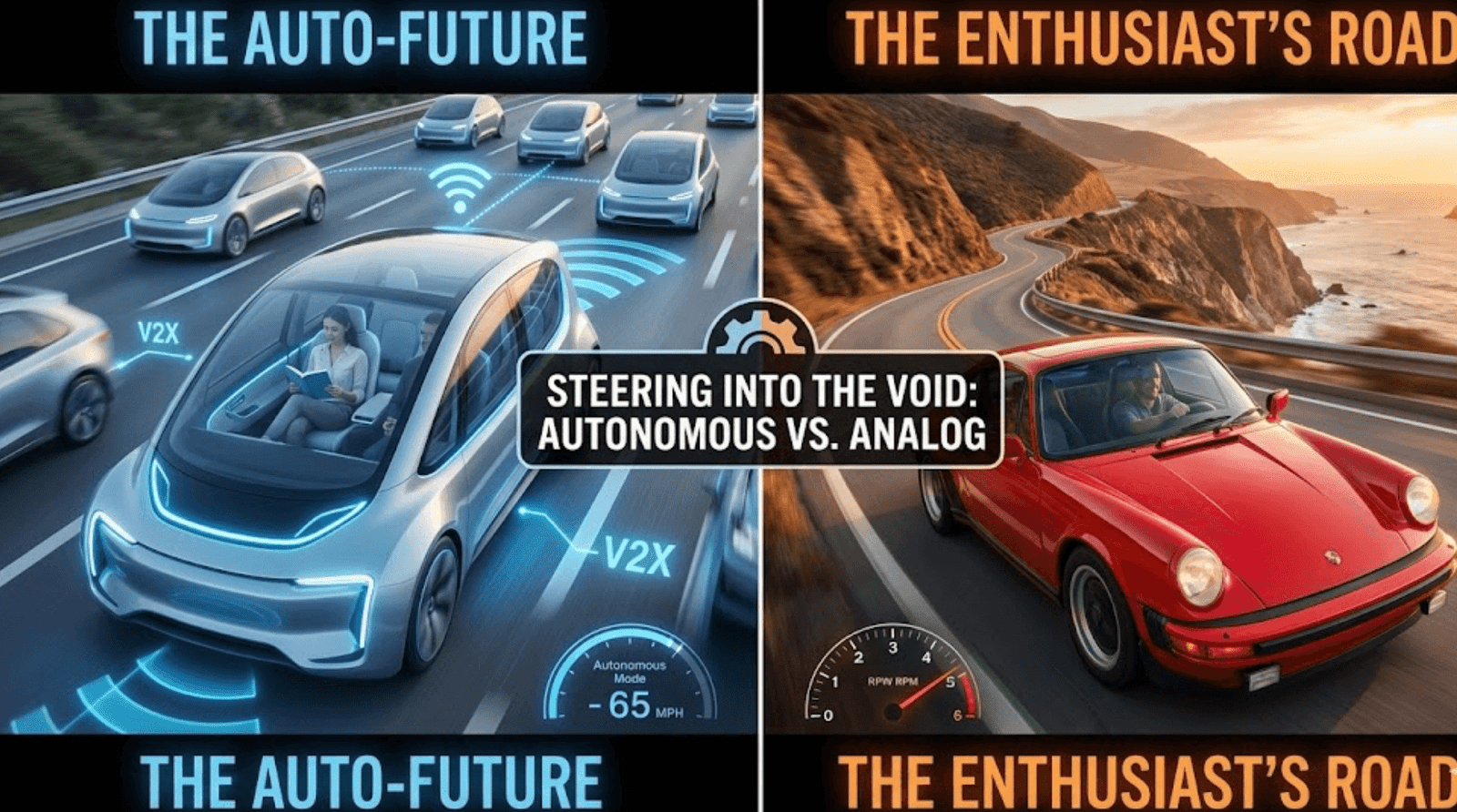
The sun is rising over a suburban street in 2026, and the sounds of the morning are changing. Ten years ago, you would have heard the rhythmic idling of internal combustion engines a chaotic symphony of vibrations and mechanical coughs. Today, that sound is increasingly replaced by a high-pitched, almost imperceptible hum.
A white, sensor-laden SUV glides past. There is no one in the driver’s seat. It doesn’t speed, it doesn’t swerve, and it certainly doesn’t “feel” the road. It is a masterpiece of silicon and code, a Level 4 autonomous vehicle performing its duty with the cold precision of a calculator.
But two blocks away, a garage door slides open to reveal something different. A polished, manual-transmission sports car perhaps a Porsche 911 or a restored vintage BMW rumbles to life. The driver reaches for the gear shifter, feels the mechanical resistance of the transmission, and smiles.
We have officially entered the era of the Great Automotive Schism. On one side, we have the “Auto-Future,” where the car is a mobile living room, a utility meant to reclaim our time. On the other, we have the “Real Driving Enthusiast,” for whom the car is an extension of the self a final frontier of human agency in an automated world.
Is there room on the asphalt for both? Or are we watching the slow extinction of the driver?
The Rise of the “Passenger Economy”
To understand the enthusiast’s anxiety, you first have to understand the sheer, undeniable logic of the autonomous movement. For the average commuter in cities like Los Angeles, London, or Gurugram, driving isn’t a “visceral experience.” It is a chore. It is a 90-minute battle with brake lights, exhaust fumes, and the mounting stress of human error.
In 2026, companies like Waymo and DeepRoute.ai have proven that the “Passenger Economy” is no longer a Silicon Valley pipe dream. Commercial robotaxi services are now operational in dozens of global hubs. For these users, the car is a service, not a possession.
The data is hard to argue with. In recent Senate hearings and safety reports, autonomous systems have demonstrated a significantly lower rate of serious injury crashes compared to human-driven miles. Humans get tired; AI doesn’t. Humans get distracted by a text message; a LiDAR sensor scans the environment 360 degrees, 20 times per second, without blinking.
From a purely utilitarian standpoint, the self-driving car is the greatest advancement in public safety since the seatbelt. But for the enthusiast, safety is only half the story.
Why We Still Grip the Wheel: The Psychology of the Enthusiast
If you ask a purist why they refuse to give up control, they won’t talk about safety. They will talk about connection.
A “real car” (in the enthusiast’s lexicon) is a machine that requires a dialogue. When you turn the steering wheel of a high-performance vehicle, the resistance you feel the “feedback” tells you exactly how much grip the front tires have. When you downshift, the engine’s roar isn’t just noise; it’s a status report on the vehicle’s state of play.
Research into automotive psychology suggests that for many, driving is one of the last remaining high-skill “flow” activities in daily life. In an era where most of our decisions are mediated by algorithms from what we eat to who we date the act of physically piloting a 3,000-pound machine at speed is a rare moment of total, unmediated responsibility.
For the enthusiast, the “Auto-Future” feels less like progress and more like castration. If the car does everything, the driver becomes a redundant sensor. The thrill of nailing a perfect corner on a canyon road is replaced by the sterile comfort of a padded cabin.
The Manufacturer’s Dilemma: Porsche, Ferrari, and the “Soul” of 2026
No one feels this tension more acutely than the makers of high-performance cars. Brands like Ferrari and Porsche find themselves walking a razor-thin tightrope.
Take the Ferrari Elettrica, launched early this year. Ferrari’s engineers faced a monumental task: how do you build an electric, potentially autonomous-capable car that still feels like a Ferrari? Their solution wasn’t just in the 0-60 mph times; it was in the “emotive” hardware. Ferrari has invested millions in synthetic soundscapes and “active” steering feel to ensure the driver remains at the center of the experience, even if the fuel is electrons instead of gasoline.
Porsche, meanwhile, has championed the “Two-Car” philosophy. Their latest infotainment systems offer Level 3 autonomy for the soul-crushing traffic of the Autobahn, but they have notably kept the manual gearbox as an option on their flagship performance models. They recognize that their customers want to be “passengers” during the week and “pilots” on the weekend.
Even Lamborghini has pivoted, using “Physical AI” not to take the wheel away, but to act as a digital co-pilot a system that nudges the driver toward the racing line without actually overriding their input. It’s “augmented driving,” intended to make a human better, not make a human obsolete.
The Environmental and Urban Shift
The debate isn’t just happening in the garage; it’s happening in city hall.
Urban planners are increasingly vocal about the benefits of a “driverless” city. Autonomous fleets require 80% less parking space because the cars never need to sit idle; they drop you off and move on to the next passenger. This reclaimed land can be turned into parks, housing, or pedestrian zones.
For the enthusiast, this represents a shrinking of their playground. We are already seeing “Autonomous-Only” zones in certain European city centers. If you want to drive your vintage 1990s manual car into the heart of the city, you may soon find yourself facing a “Human Driver” surcharge or a flat-out ban.
This is where the “Real Car” enthusiast faces their biggest threat: not from the technology itself, but from the infrastructure. If the roads are optimized for cars that talk to each other through 5G and V2X (Vehicle-to-Everything) communication, a human driver becomes a “wild card” an unpredictable element that breaks the efficiency of the hive mind.
The Future: Driving as a Hobby, Not a Necessity
Where does this leave us? The most likely outcome is that driving will follow the same path as equestrianism.
In 1900, horses were a primary mode of transport a necessity. By 1950, they were a hobby. Today, people still love horses, they still ride them, and they still breed them for performance. But they don’t ride them to the grocery store.
We are moving toward a world where the “Driverless Pod” handles the commute, and the “Driver’s Car” is reserved for the track, the private club, or the designated “Heritage Road.”
Enthusiasts in 2026 are already flocking to private track memberships and “recreational driving” resorts. These are spaces where the rules of the road are replaced by the rules of the circuit, and where the visceral thrill of an internal combustion engine is preserved as a luxury experience.
The Human Verdict
The era of the autonomous car doesn’t have to be the death of the enthusiast; it might actually be its salvation.
By removing the “drudgery” of driving the traffic, the parking, the mundane grocery runs we might actually find that the time we do spend behind the wheel becomes more precious. When driving is no longer a requirement, it becomes a choice. And for those who love the machine, there is no choice more powerful than that.
The road ahead is wide enough for the robot and the rebel. The trick will be ensuring that as we build the silicon brains of the future, we don’t forget the human heart that first taught us to love the open road.
What do you think? Are you ready to hand over the keys for a stress-free commute, or will you be the one keeping the manual transmission alive until the very end? Let’s hear your take in the comments.
🏎️ The Enthusiast’s Checklist
Would you like me to create a “Buyer’s Guide for the Last Great Manual Cars” a list of the best 2026-ready vehicles that still put the driver in total control?
Leave a Reply