
If you thought the AI funding wars of 2024 were intense, January 2026 just said, “Hold my GPU.”
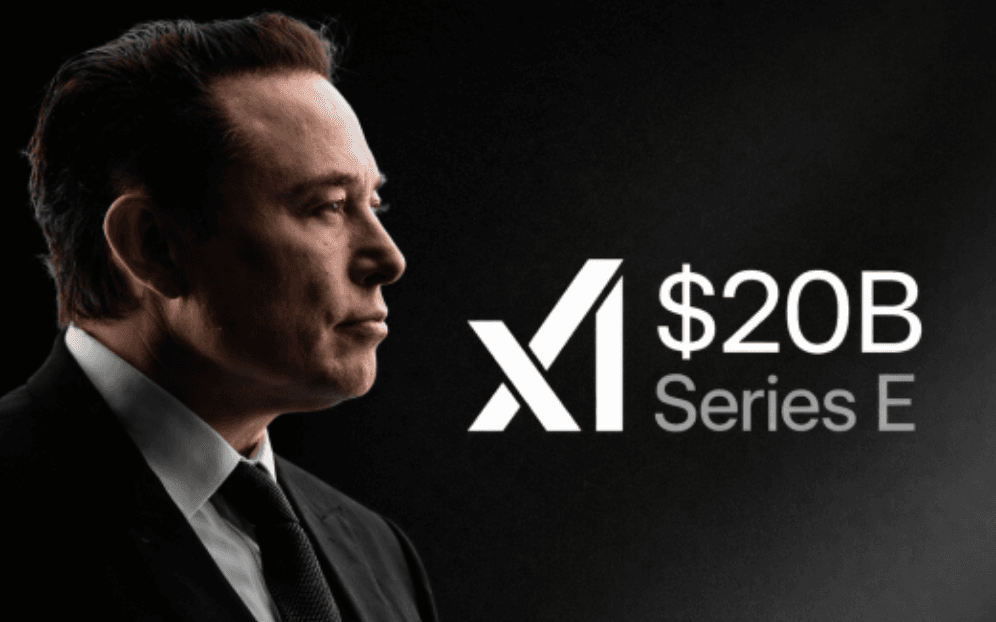
This week, Elon Musk’s xAI officially closed an upsized $20 billion Series E funding round, catapulting the company’s valuation to a staggering $230 billion. To put that in perspective, xAI is now valued higher than the market cap of Disney, Nike, or Intel.
For a company that didn’t exist three years ago, that’s not just growth—it’s a vertical takeoff. But behind the eye-popping numbers lies a much deeper story about the “Brute Force” era of artificial intelligence.
Why are investors like Nvidia, Fidelity, and the Qatar Investment Authority dumping billions into a company that is still chasing OpenAI and Anthropic? Let’s look at the three pillars supporting this $230 billion bet.
1. The Colossus Advantage: Building the “Computing Giga-factory”
While other AI labs are busy debating safety protocols, Musk is busy pouring concrete. The primary destination for this $20 billion isn’t just researcher salaries; it’s the expansion of Colossus, xAI’s massive supercomputer cluster in Memphis.
As of this week, xAI confirmed that Colossus now hosts over one million H100 GPU equivalents.
In the AI world, compute is the new oil. By amassing the world’s largest single-site AI training facility, xAI is betting that “brute force” scaling will eventually allow Grok to leapfrog GPT and Claude. They are building a 2-gigawatt data center enough power for 1.5 million homes—to train Grok 5. In 2026, the winner isn’t necessarily the one with the best code; it’s the one with the most electricity and silicon.+1
2. The “X + Tesla + Optimus” Flywheel
Investors aren’t just buying a chatbot; they are buying an ecosystem. xAI has a “data advantage” that its competitors simply can’t replicate:
- Real-Time Data from X: Grok has a 24/7 direct feed into the global conversation. While other models are trained on static datasets, Grok is learning from what is happening right now.+1
- The Tesla Connection: Musk has hinted at integrating xAI’s “reasoning” capabilities into Tesla’s Full Self-Driving (FSD) and, more importantly, the Optimus humanoid robot.
- Optimus is the “Body” for Grok’s “Brain”: If Hyundai is building 30,000 Atlas bots (as we discussed in our last blog), Musk wants Optimus to be the smartest of the bunch. This $230B valuation reflects the belief that xAI will be the software engine for millions of physical robots in the near future.
3. The Nvidia-Cisco Strategic Handshake
The most interesting part of this $20 billion round is the participation of Nvidia and Cisco.
Nvidia is the primary beneficiary of the AI boom, but their investment in xAI is a clear signal that they see Musk as their most aggressive customer. By backing xAI, Nvidia ensures that the next-generation Rubin chips (the successor to Blackwell) have a massive, ready-made home.
Cisco’s involvement suggests a move toward Enterprise AI. xAI isn’t just for edgy tweets anymore; with the launch of “Grok Enterprise” and its recent integration with Google Drive and cybersecurity tools, they are coming for Microsoft’s lunch.
The Human Verdict: Is it a Bubble or a Bridge?
A $230 billion valuation for a company with relatively modest revenue compared to OpenAI (which is currently valued at $500B) is a massive gamble. It assumes that the “Scaling Laws” hold true that if you keep adding more GPUs and more power, the AI will eventually achieve AGI (Artificial General Intelligence).
Critics argue that xAI is facing mounting regulatory pressure over Grok’s content moderation and environmental concerns regarding the Memphis data center’s massive power draw.
However, in the “Year of the Agent,” Musk is playing a different game. He isn’t trying to build a polite assistant; he’s building a “Truth-seeking” AI that powers the physical world—from the cars we drive to the robots that will eventually work in our factories.
What’s your take? Is xAI’s $230 billion valuation a sign of an AI peak, or is this just the beginning of the “Compute Hegemony”?