
If you thought NVIDIA was done after becoming the most valuable company in the world, you haven’t been paying attention to Jensen Huang.
The leather jacket was back on stage in Las Vegas yesterday, and while the gaming community was screaming for new graphics cards (don’t worry, we got them), the broader message was much scarier and more exciting.
NVIDIA isn’t just selling chips anymore. They are effectively trying to become the operating system for the physical world.
From a new GPU architecture that makes Blackwell look quaint to the “ChatGPT moment” for robots, here is the breakdown of everything NVIDIA dropped at CES 2026.
1. The Big One: Enter “Vera Rubin”
Just as the industry was getting used to the Blackwell chips, NVIDIA hit the accelerator. Jensen officially unveiled the Rubin architecture (named after astronomer Vera Rubin), the successor to Blackwell.
- The Promise: 5x the performance of Blackwell with significantly lower power consumption.
- The Tech: It uses the new HBM4 memory (likely the result of that Samsung partnership we discussed earlier) and is designed specifically to handle the “reasoning” phase of AI where models stop just guessing the next word and start actually thinking through problems.
- Availability: Shipping late 2026. If you are a data center manager, I am sorry for your budget anxiety.
2. Gamers, Rejoice: The RTX 50 Series is Here
After months of rumors and leaks, the GeForce RTX 50 Series is official. And yes, it is a monster.
- RTX 5090: The new king of the hill. It’s physically massive, expensive, and apparently capable of running Cyberpunk 2077 with full path tracing at 8K without breaking a sweat.
- The Lineup: We also got the RTX 5080 (the sweet spot for high-end gamers) and confirmations of the 5070 and 5060 arriving later this spring.
- DLSS 4.5: The real magic isn’t the hardware; it’s the software. The new DLSS 4.5 introduces “Dynamic Multi-Frame Generation.” It doesn’t just insert one fake frame between real ones; it can seemingly generate sequences of frames to smooth out stuttering in a way that feels like black magic.
3. Alpamayo: The “Thinking” Car
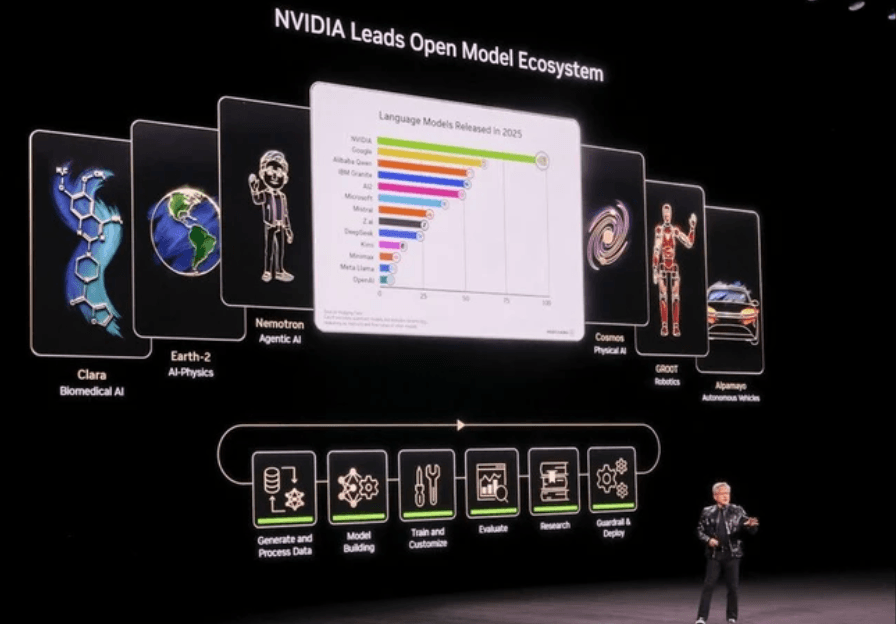
This was the sleeper hit of the keynote. NVIDIA announced Alpamayo, a new family of open-source AI models designed specifically for autonomous vehicles.
Here is the difference: Old self-driving cars were reactive (“I see a pedestrian, I stop”). Alpamayo is reasoning-based. It can look at a complex situation—like a construction worker waving a flag while standing in the wrong lane and understand the context rather than just following hard-coded rules.
- Real World Debut: It’s not just theory. Mercedes-Benz confirmed they are putting this tech into the new CLA class, launching as early as Q1 2026. Your next car might actually have common sense.
4. The “ChatGPT Moment” for Robots
Jensen kept repeating a phrase: “Physical AI.”
For years, robots have been dumb. They can weld a car door, but they can’t fold laundry because laundry is unpredictable. NVIDIA introduced Project GR00T N1.6 and the Cosmos platform to fix this.
- Cosmos: This is a “world model.” It simulates the laws of physics so robots can learn how to walk, grab, and interact in a virtual world before they ever try it in the real world.
- The Result: We saw demos of humanoid robots that learned to perform complex tasks (like packing a suitcase) in hours rather than years. If 2023 was the year of the Chatbot, 2026 is officially the year of the Android.
5. The “Supercomputer on Your Desk”
Finally, for the developers and researchers who can’t afford a data center, NVIDIA launched DGX Spark.
It looks like a sleek, oversized PC tower, but it’s actually a “deskside supercomputer.” It packs the new GB300 superchip and is designed to let companies fine-tune massive AI models locally without sending their sensitive data to the cloud. It’s a clear play to get NVIDIA hardware into every office, not just every server farm.
The Takeaway
NVIDIA is done playing the same game as Intel or AMD. They aren’t just selling the engine; they are building the roads, the traffic lights, and the maps.
Whether you are a gamer wanting higher frame rates or a logistics manager waiting for robots that actually work, NVIDIA just set the tempo for the rest of the year.