
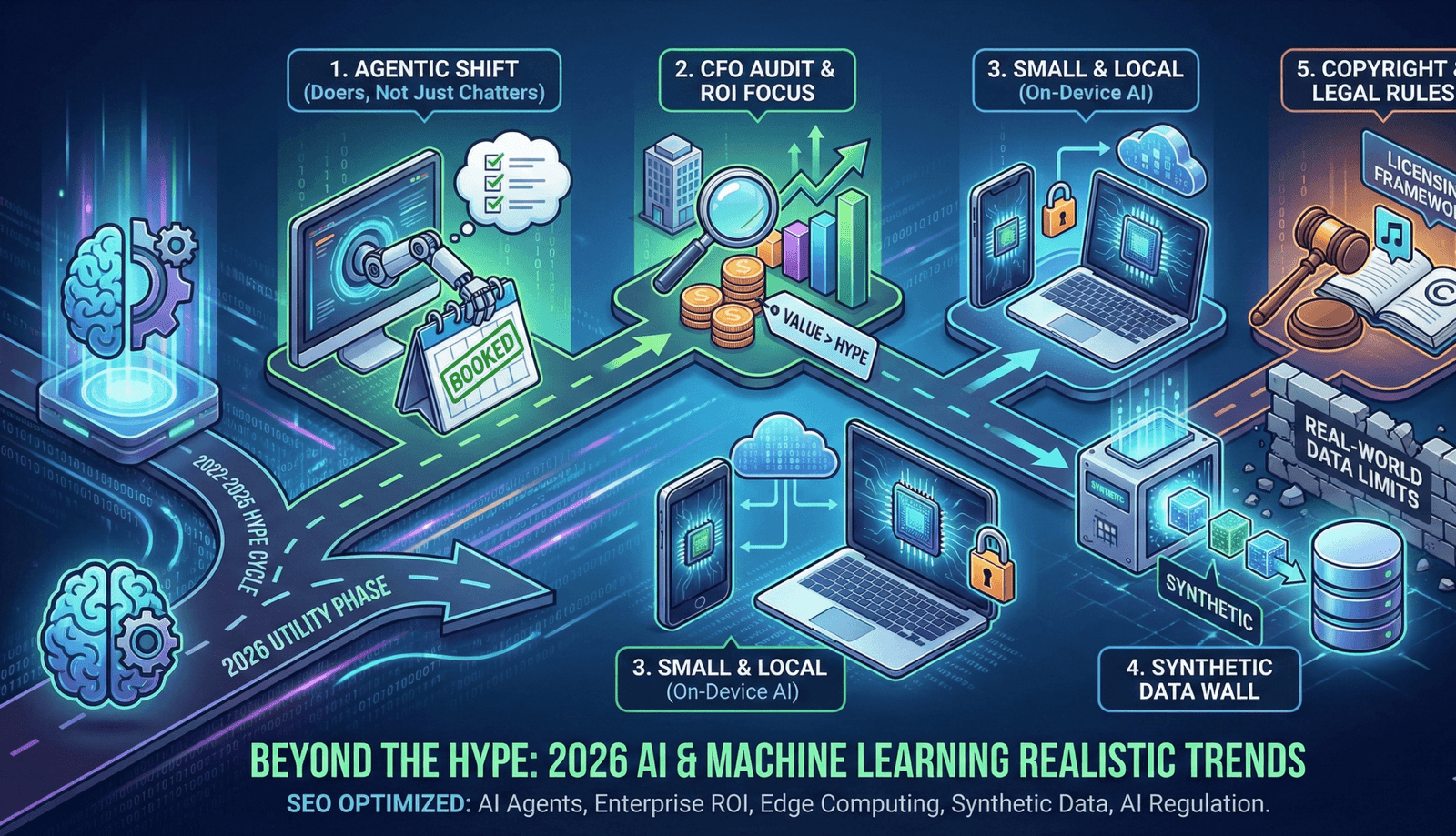
If you feel like you’ve been living in a wind tunnel of AI announcements for the last three years, you’re not alone. Since ChatGPT kicked down the door in late 2022, we’ve been in a breathless sprint of “bigger, faster, smarter.”
But stepping into 2026, the vibe feels different. The frantic energy of the initial gold rush is settling into something more pragmatic. We aren’t just staring awe-struck at what AI can do anymore; we are starting to ask tough questions about what it should do, how much it costs, and whether it’s actually useful.
2025 was the year of prototypes and promises. 2026 is shaping up to be the year of deployment and discipline. We are moving from the “wow factor” phase into the “utility phase.”
Based on the trajectory of the last twelve months and conversations with engineers, investors, and nervous CFOs here are my five predictions for the real-world landscape of Artificial Intelligence and Machine Learning in 2026.
1. The Great “Agentic” Shift: The Death of the Chatbot
For three years, our primary relationship with AI has been a text box. We type a prompt, wait a few seconds, and get text back. It’s a call-and-response dynamic that, quite frankly, is starting to feel dated.
As I discussed in my analysis of Meta’s recent $2 billion acquisition of Manus AI, 2026 is the year the interface changes. We are moving from Chatbots (which talk) to AI Agents (which act).
The limitation of current LLMs isn’t intelligence; it’s agency. They are brains in a jar. They can write a five-star itinerary for a trip to Paris, but they can’t book the flights, reserve the Airbnb, or buy the museum tickets. You still have to do the “last mile” of digital drudgery.
By the end of 2026, “agentic workflows” will become the standard. You won’t be impressed that an AI can write an email; you’ll expect it to draft the email, find the correct recipient in your CRM, send it, and proactively nudge you when the reply comes in. The best AI companies this year won’t be the ones with the biggest models; they will be the ones that build the most reliable bridges between the model and the real world.
2. The “CFO Audit” Hits Enterprise AI
Remember all those glittering press releases in 2024 and 2025 about companies “integrating generative AI”?
Well, the bill is coming due.
For the last two years, corporate boards gave CTOs blank checks so they wouldn’t look behind the curve. Thousands of pilot programs were launched. In 2026, the CFOs are stepping in with a simple question: “Where is the ROI?”
We are about to see a massive shakeout in enterprise AI. Many companies will realize that shoving a generic LLM into their customer service workflow didn’t save money it just created new, weird problems for human agents to fix.
The prediction here isn’t that enterprise AI dies; it’s that it gets serious. The vanity projects will be defunded. Investment will flow aggressively toward specific, boring, high-value use cases—like predictive maintenance in manufacturing, complex fraud detection in finance, and highly specialized legal document review. The hype is over; show me the money.
3. Small (and Local) Becomes Beautiful
There is a dirty secret in the AI world: running massive models in the cloud is expensive, energy-hungry, and slow. Every time you ask a cloud-based AI to summarize a document on your phone, that data has to travel halfway across the world and back.
2026 will see a massive pendulum swing toward Small Language Models (SLMs) running “at the edge”—meaning, directly on your laptop, phone, or even in your car.
Apple, Qualcomm, and Google have spent years building dedicated AI silicon into their devices. We are finally at the point where the software can take advantage of it. Why does this matter?
- Privacy: Your sensitive financial documents don’t need to leave your laptop to be analyzed by an AI.
- Speed: No network latency. The AI feels instant.
- Cost: Companies stop paying exorbitant cloud compute fees for simple tasks.
Expect to see “offline AI” become a major selling point for consumer hardware this year.
4. We Hit the “Synthetic Data” Wall (and Climb Over It)
Here is the existential crisis facing the giants like OpenAI and Google: they have basically read the entire internet. They have trained their models on nearly every high-quality book, article, and forum post available.
To make models smarter, they need more data. But where does it come from?
If they start training future models on content generated by current models, they risk a “model collapse”—a digital version of inbreeding where the AI becomes weird, repetitive, and detached from reality.
In 2026, the biggest breakthroughs in ML research won’t be about making models bigger; it will be about figuring out synthetic data. How do we programmatically generate high-quality, factual data to teach AI concepts it can’t find on Reddit? The companies that solve the “data quality” bottleneck will win the next phase of the arms race, not necessarily the ones with the most GPUs.
5. The Copyright Wars Yield the First Real Rules
Up until now, generative AI companies have operated under the flimsy shield of “fair use,” scraping artists’, writers’, and musicians’ work without explicit permission to train their models. The lawsuits have been piling up, but the courts have been slow.
2026 is likely the year we get the first landmark legal precedents that define the future of creative industries. We will move past the theoretical debates and get concrete rulings on whether training an AI on copyrighted work is infringement.
My prediction? A messy compromise. We will likely see a licensing framework emerge, similar to how Spotify pays musicians. AI companies will have to pay “data royalties” to major publishers and record labels. This will legitimize the industry, but it will also raise the drawbridge, making it much harder for small AI startups to compete with the well-funded giants who can afford the licensing fees.
The Human Element Remains
If there is one theme for 2026, it’s integration.
The alien technology has landed. Now we are figuring out how to fit it into our offices, our homes, and our laws without breaking everything. It’s going to be a messy, frustrating, and incredibly productive year.
The most successful people in 2026 won’t necessarily be the elite coders. They will be the adaptable ones—the people who can look at a workflow, understand what an AI agent can handle, and reorganize the human team to focus on the strategy, empathy, and judgment calls that the machines still can’t touch.